


Ezeụgbọ: Save the Soil, Save the Yam
Asaba came alive.
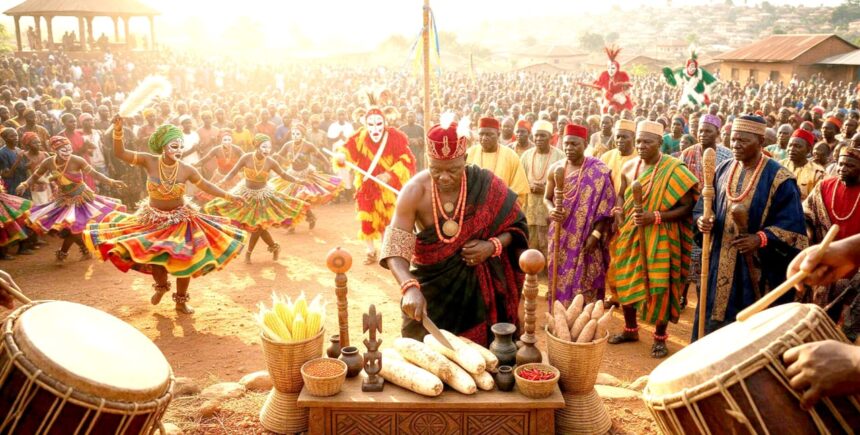
Roads were crowded with people who had travelled from near and far to witness the spectacle. Drums rolled, trumpets blared and songs rose above the excited chatter. Dancers spun and stamped their feet in rhythmic thanksgiving.
It was Ezeụgbọ, the age-old harvest festival of the Asaba people, returning with renewed colour and purpose under the watchful presence of the Ayiwe, who traditionally stands as priest of the god of harvest.
But beneath the drums, dancing and pageantry lies a message that should not be drowned by the noise: Ezeụgbọ is not simply a festival. It is a celebration of the soil, the harvest and the people whose labour makes both possible.
At the heart of it all is the yam.
For the Igbo, yam has never been merely another food crop. It represents labour, endurance, prosperity and the reward for patiently working the soil. A farmer does not plant yam today and harvest it tomorrow. There is planting, weeding, tending, waiting and hoping before the reward finally emerges from the earth.
That is why Iwaji, the ceremonial cutting and tasting of the new yam, carries such significance.
The Ayiwe does not merely take a ceremonial bite. After the new yam has been presented and blessed, he tastes it. By doing so, he traditionally signals to the people that the harvest has arrived and they can now begin to eat the new yam.
In simple terms, the Ayiwe says: the waiting is over. The yam is ready.
And that is what makes Ezeụgbọ the climax of the agricultural cycle.
The farmer has planted. The soil has responded. The crop has matured and the harvest has been gathered. Now the community can celebrate and partake in the fruits of the season.
In earlier times, Ezeụgbọ was also a proud display of agricultural abundance. Farmers brought out huge yam tubers alongside maize, cassava, pepper and other crops. It was a celebration of productivity and a public acknowledgement of the sweat that went into feeding the community.
But today, the festival raises an uncomfortable question:
What happens to Ezeụgbọ when the farmland that produces the yam disappears?
That is the paradox staring Asaba in the face.
The city is expanding. Farmlands are steadily giving way to houses, roads and other developments. At the same time, farming is losing its attraction among many young people who are pursuing trading, professional careers, politics and the digital economy.
There is nothing wrong with those pursuits. The danger lies in celebrating an agricultural heritage while gradually destroying the agricultural foundation on which it rests.
Without land, what happens to yam?
Without yam, what happens to Ezeụgbọ?
And without Ezeụgbọ, what happens to a tradition that has helped generations of Asaba people remember their relationship with the soil?
These are not merely cultural questions. They are questions of food security and survival.
A society cannot forever celebrate the harvest while neglecting the farmer and the land that produce it. Imported food may fill our markets but it cannot replace the security that comes from having the capacity to produce what we eat.
That is why the agricultural message of Ezeụgbọ deserves as much attention as its colourful spectacle.
The Asagba’s emphasis on preserving the dignity and traditional character of the festival is therefore important. Cultural celebrations should not become excuses for disorder, criminality or empty fanfare. Their deeper values—thanksgiving, hard work, peace, communal unity and respect for tradition—should remain at the centre.
The security measures adopted during the celebration also underscored the need to protect its dignity. A festival that brings people together should provide a safe environment for families, visitors and participants.
But the responsibility for keeping the tradition alive does not belong to traditional institutions alone. The younger generation has a crucial role to play.
Culture is not something to dust off once a year, wear colourful clothes for and forget afterwards. It is a living inheritance. If Ezeụgbọ is to remain meaningful, its story must be understood and passed on.
More importantly, its agricultural foundation must be protected, especially in an era of genetically modified crops, industrialised food production and growing dependence on food from outside our communities. Whatever one’s view of modern agricultural technology, there is wisdom in preserving indigenous crops, local farming knowledge and the ability to produce wholesome food from our own soil.
There is also an opportunity for Asaba to think beyond the annual celebration. Ezeụgbọ can become a stronger cultural and tourism attraction, creating economic opportunities while showcasing Asaba’s identity. But development must not strip the festival of the very tradition that gives it meaning.
When the Ayiwe tastes the new yam, therefore, something much bigger than a ceremonial meal takes place.
A farming cycle has reached its climax.
The community receives the traditional signal that the harvest is ready. The people can eat, celebrate and give thanks. Then the cycle begins again.
That is the beauty of Ezeụgbọ.
It reminds Asaba that before there was the city, there was the soil; before there was the celebration, there was the farmer; and before there was the feast, somebody had to plant the yam.
So, as we celebrate Ezeụgbọ, perhaps the loudest message should not come from the drums.
It should come from the soil.
Save the soil. Save the yam. Save Ezeụgbọ.
Okiwelu Azed P. writes from Asaba.