

Asaba Will Never Forget
A Wound That Must Not Be Repeated
By Okiwelu Azed P.
Ahabamegí eji gbuwe na ahia? (‘What offence did the people of Asaba commit to deserve such killing?’)
I grew up hearing that sentence again and again from the elders—so often that it became a kind of heartbeat. It carried more than words. It carried the bewilderment, grief and unanswered questions of a people who witnessed something they could never fully explain.
Asaba will never forget. That is not a slogan. It is how a place carries its wound.
The Asaba Massacre happened nearly six decades ago yet its pain remains lodged in the town’s memory. Time may blur particulars but it cannot erase the trauma of those who witnessed the killings or lost fathers, brothers, husbands, sons and other relatives. No one understands that enduring agony better than the families who lived through it and those who inherited its memory.
On 7 October 1967, at the height of the Nigerian Civil War, federal troops under Colonel Murtala Mohammed advanced into Asaba and rounded up civilians at various locations. Men and boys were separated from women and children. Many, including elderly men and boys barely into their teens, were taken to the Ogbeosowa village square, lined up and shot. Gunfire tore through the air. Cries of anguish filled the streets. Property was looted, homes were destroyed and women and girls were subjected to sexual violence.
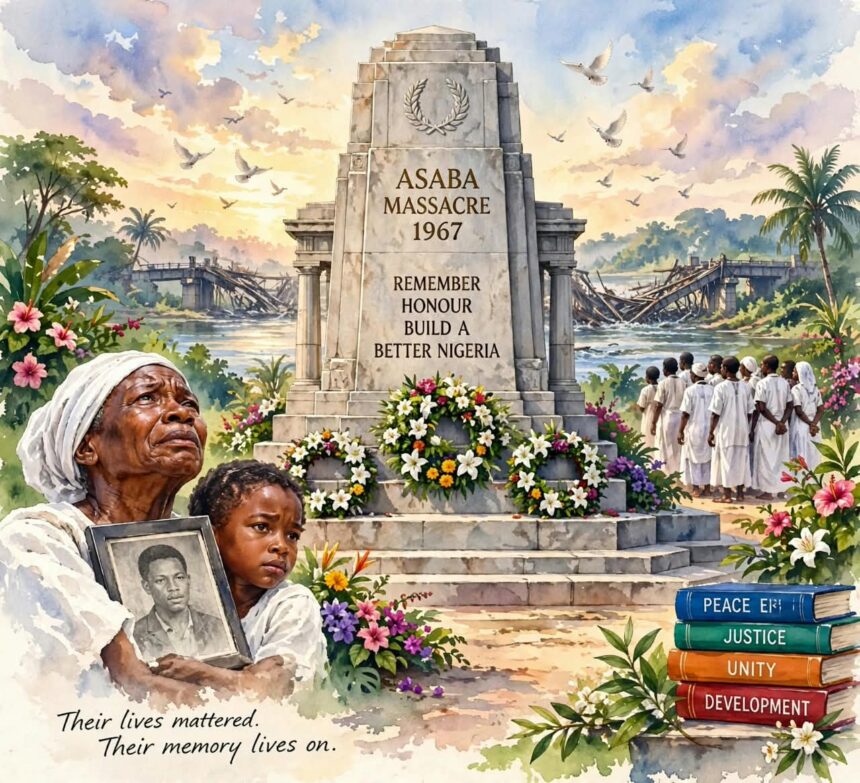
They had gathered in their ákwá ọcha, the white clothes worn as a symbol of peace and reconciliation, believing their dress would signal loyalty to a united Nigeria. They were not dressed for war. They were civilians expressing a simple message: we want peace.
Instead, that gesture became a tragic symbol. Fathers did not come home. Mothers waited in vain. Sons and brothers never returned. The town was left with shallow graves and a trauma passed down through generations.
What crime had these unarmed civilians committed? For the people of Asaba there has never been an answer adequate to the scale of their suffering.
The killings occurred within a wider national catastrophe. From 1967 to 1970, after the Eastern Region declared the independent Republic of Biafra, the conflict unleashed military confrontation, mass displacement, hunger and enormous loss of life. Yet Asaba’s story carries a particular pain. The massacre did more than take lives. It shattered families, disrupted the community’s social fabric and left psychological scars that survive long after the guns fell silent.
Remembering Asaba is not about reopening old wounds for revenge. It is about refusing to let those wounds be buried beneath silence.
Silence, however, can become another wound. After the war the Federal Government promoted the three Rs: Reconciliation, Reconstruction and Rehabilitation. Roads were rebuilt, institutions resumed and life moved forward. But psychological reconstruction is different. A destroyed house can be rebuilt with cement and steel. A destroyed family cannot be reconstructed so easily. Reconciliation without truth is fragile. Forgiveness without acknowledgement can become a further burden placed on victims.
For decades the Asaba massacre received far less national attention than its magnitude demanded. That absence of a comprehensive reckoning deepened the sense that the victims had been pushed into the shadows. A nation cannot build lasting peace by asking its citizens to forget what happened to them. It must remember with them, listen to them and when necessary have the courage to say: this should never have happened.
Acknowledgement can heal. A sincere official apology from the Federal Government would not bring the dead back but it would carry enormous symbolic weight. It would tell their descendants that the state recognises their suffering and accepts that their history is part of the nation’s history.
At the 50th anniversary, Bishop Matthew Hassan Kukah urged a confrontation with the painful truths surrounding the massacre and called for reconciliation with the victims’ families. That is the language of healing, not revenge. Nigeria has created spaces for painful truth before. The Human Rights Violations Investigation Commission, popularly known as the Oputa Panel, showed that victims can be heard in public and that historical grievances can be examined honestly. A similar process devoted to unresolved civil war atrocities would not be an act of revenge. It would be an act of nation-building.
But forgiveness is not forgetting. Asaba can forgive without surrendering its memory. Indeed, remembering responsibly may be one of the most generous forms of forgiveness because it allows the dead to speak without demanding that the living inherit their anger. Vengeance belongs to God. Justice belongs to society.
Justice need not always mean punishment. It can mean acknowledgement, restitution, memorialisation, education and a solemn commitment to prevent recurrence. Reparations therefore deserve serious national consideration. They could include compensation, public acknowledgement, memorials, museums, educational programmes and targeted investment in affected communities.
The objective is not to put a price on human life. No amount of money can do that. The objective is to show that the state understands that injustice has consequences and that victims deserve recognition.
One of the most effective ways to prevent history from repeating itself is to teach it honestly. The civil war should not be reduced in our schools to dates, battle maps and political slogans. Students should learn its human consequences: killings, displacement, hunger, destruction and long-term trauma. They should understand how ethnic suspicion and political exclusion can turn disagreements into violence. Behind every statistic was a person: a father, a mother, a child, a brother, a sister, a friend. Our past must be a warning, not a blueprint.
The late Ogbueshi Professor Emma Okocha (Ikemba Ahaba) kept Asaba’s memory alive through Blood on the Niger and other documentation. When official records are incomplete, books, testimonies, photographs and oral histories become guardians of truth.
Asaba should therefore have a permanent institution dedicated to memory and peace—perhaps a federal university or a properly funded Asaba Peace and Memory Centre—together with a museum and memorial to honour the dead. Such a memorial would not glorify hatred. It would honour life and remind future generations that these deaths must never become a precedent.
Peace education must also reach beyond the classroom. It should extend into communities, churches, mosques, traditional institutions and political organisations. An annual Asaba Peace and Memory Forum could bring together survivors, historians, students, artists, researchers – policymakers for essays, films, exhibitions and oral-history projects. Members of the National Youth Service Corps could take part in community peace initiatives and restaurants and organisations could host anti-war cultural evenings whose proceeds support orphanages, homes for the elderly and other vulnerable people. Memory should live in institutions, art and community action—not only in speeches.
A crucial lesson from Asaba is that citizens must never feel that the state is their enemy. Legitimacy depends on trust. Where people believe the law favours some and punishes others, resentment grows and separatist sentiment can take root. National unity cannot be sustained by force alone. It must rest on fairness, equality before the law, security, dignity and belonging.
This principle applies to contemporary conflicts. Cattle rearing is a legitimate economic activity but it must operate within the law. Open grazing that destroys farms or leads to violent confrontation cannot be defended as a cultural entitlement. Criminal acts must be investigated and prosecuted regardless of ethnicity or religion. A modern state builds trust when the law is blind to identity.
The killings at Odi in 1999 and Zaki Biam in 2001 should also remind us that when state power is exercised without credible accountability, civilian trust collapses. The conviction of Charles Taylor by an international tribunal showed that political power does not automatically confer impunity. Nigeria must strengthen institutions capable of investigating abuses and protecting citizens whoever holds office. State instruments are not personal weapons. They belong to the people.
There is another lesson woven into the tragedy of war: necessity is often the mother of invention. My visit to the Umuahia War Museum brought this sharply into focus. The ingenuity displayed during the civil war, including improvised technologies such as the ogbunigwe developed under extraordinary pressure, demonstrates the depth of Nigerian creative capacity. The lesson is not to glorify instruments of destruction but to recognise what Nigerians can achieve when compelled to solve difficult problems with limited resources.
Imagine what that same ingenuity could achieve when directed towards peaceful development and properly supported by research, funding and institutions. Nigeria should invest more seriously in indigenous science, engineering, agriculture and technology. The greatest expression of our ingenuity should not be our ability to manufacture instruments of destruction but our capacity to manufacture prosperity, solve problems and compete confidently in the world.
The danger of political exclusion also deserves serious attention. When citizens feel excluded, humiliated or treated as second-class members of the national community, the value of the union itself can be questioned. Good governance is a security strategy. So are justice, equality and human rights. A government that makes citizens feel protected is less likely to face rebellion than one that makes them feel permanently threatened. Nigeria must therefore strengthen democratic institutions, deepen national dialogue and address grievances before they become crises.
The social media age makes this even more urgent. Digital platforms can spread hatred and misinformation with frightening speed but they can also become powerful tools for peace education. Imagine a national campaign built around three simple sentences: Remember Asaba. Reject hate. Choose peace. That message could reach millions.
The people of Asaba have lived, worked and contributed to Nigeria despite the trauma carried by their history. They have welcomed people from other regions, built businesses and raised families. That resilience should not be mistaken for amnesia. Some survivors remain. Some who witnessed the events may still be alive. That makes the moral responsibility for reconciliation even more urgent. There is still time to listen, to acknowledge and to build something worthy from the ruins of memory.
The dead cannot return but their memory can save the living. We remember not to nurture hatred or seek revenge but to ensure that another generation does not inherit the blindness that allowed ordinary citizens to become victims of extraordinary violence.
Asaba’s story belongs to all Nigerians. It is a lesson about the cost of intolerance, the danger of unchecked power and the responsibility of a nation to confront its past honestly if it hopes to build a peaceful future.
Are we truly one?
Unity is more than geography. It is justice. It is equality. It is security. It is dignity. It is belonging. That is the Nigeria we must build. And that is why Asaba will never forget.
May the people of Asaba find the grace to forgive without forgetting, to remember without hatred and to work towards a Nigeria where the horrors of 1967 can never be repeated.
Asaba lives matter. Nigerian lives matter. Every life matters.
Ozoemena!
Okiwelu Azed P. writes from Asaba.