


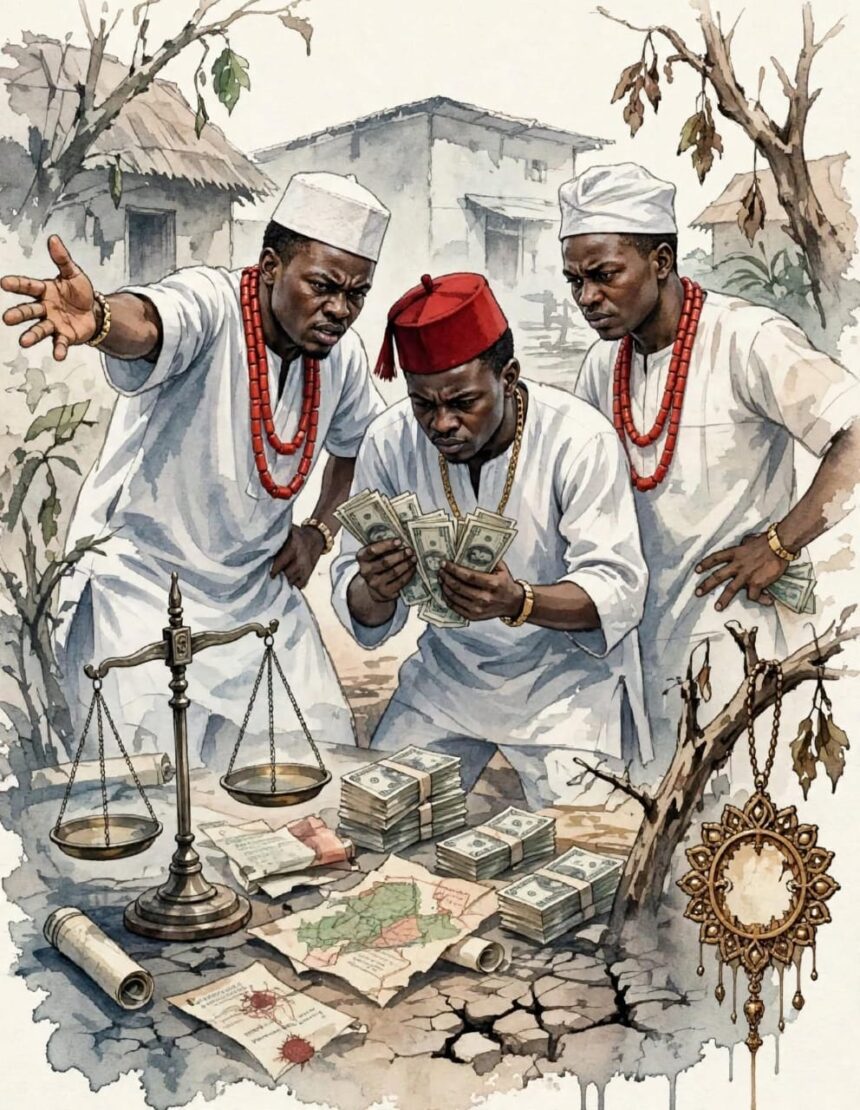
ALOR: WHEN A TITLE LOSES ITS DIGNITY
There was a time when traditional titles meant something.
They were not decorations for a name. They were not shortcuts to social recognition. They were not badges to be acquired by anyone who could afford the ceremony. They were earned through years of responsible living, hard work, integrity, family commitment and service to the community.
A man became a title holder because his life had earned him the honour.
That was the dignity attached to the Alor title in the old days.
The Ogbueshi or Alor title was not a title for boys masquerading as men. It was not intended for men still struggling to establish themselves or those who had barely begun to shoulder the responsibilities of adulthood. It was traditionally associated with men who had come of age — preferably from the Otu Ahaza age grade — and had demonstrated a reasonable level of stability in life.
These were men whose family responsibilities were substantially under control. Their children were growing. Their homes were established. Their livelihoods were known. They could feed their families without begging for money to buy pepper and crayfish to prepare ose ani delicacy.
They were farmers. Traders. Retired civil servants. Professionals. Community builders. Men whose accomplishments could be pointed to without any embarrassment.
In local parlance, Alor means ‘all is well with me’. The expression was never intended to convey mere possession of money. It represented a deeper state of accomplishment: that a man had weathered the storms of life, discharged his responsibilities and arrived at a point where he could look back with some measure of satisfaction.
That was why the title carried weight.
That was why it commanded respect.
That was why the elders took its conferment seriously.
Traditionally, the Alor title was also a prerequisite for aspiring to the Eze or Obi title — represented by the distinguished red fez cap. A man did not simply wake up one morning and decide that he wanted to become an Obi. There was a progression. There were expectations. There were responsibilities. There was a moral and financial threshold to cross.
The Alor title came first.
The Eze or Obi title came thereafter.
The arrangement was deliberate. It recognised the wisdom of allowing maturity to precede elevation and achievement to precede recognition.
The elders who approved an Alor aspirant were themselves expected to understand the gravity of what they were doing. They considered his character, family standing, reputation, livelihood, accomplishments and contribution to society.
The title was not supposed to be bestowed lightly.
It was a reward for a life well lived.
I still reminisce vividly about the days when my father bore the Alor title while my grandfather held the Obi title. There was something profoundly dignifying about those titles because the men who bore them were themselves dignified.
Apparently their character was known. Their pedigree was known. Their sources of livelihood were known. Their words carried weight because their lives had earned them the right to be heard.
They never needed to announce themselves. They never reminded anyone that they were titled men. They never demanded respect.
Respect followed them.
That is precisely what makes the situation today so troubling.
The Alor title has, in many respects, suffered a disturbing erosion of its traditional dignity. What was once a recognition of character and accomplishment is increasingly being treated by some as a ticket to social relevance.
And when a title becomes a ticket rather than a testament the institution begins to lose its meaning.
No doubt, I am a lover of tradition and culture. It is precisely for that reason that this development troubles me.
One particularly disturbing development is the emergence of individuals who accumulate wealth through questionable land transactions and subsequently seek traditional titles.
The story is familiar in many communities.
A man ventures into land deals. Parcels of land are sold indiscriminately. Sometimes the transactions are legitimate. At other times they are not. In some instances, the same piece of land is repeatedly sold to several unsuspecting buyers.
Then the trouble begins.
The buyers are left to drag one another through the courts to establish who actually owns the property. Years can pass. Money is lost. Families are destabilised. Trust is destroyed.
Meanwhile, the person who collected the money may have disappeared into another venture or another location.
One particularly telling incident was once narrated of a red-fez title holder who reportedly scaled a fence to evade people who had arrived with the police in connection with disputed land transactions in which he was reportedly involved.
If such an incident sounds almost comical it is only because the underlying reality is deeply troubling. The question it raises is unmistakable: when did questionable wealth become sufficient qualification for traditional honour?
More disturbing is what sometimes follows.
Having acquired wealth through dubious means, some individuals seek the Alor title as a form of social rehabilitation. The title provides an appearance of respectability. It gives them a place at the table. It creates the impression that they have arrived.
In effect, a traditional institution designed to recognise character can become a convenient cloak for concealing its absence.
That is dangerous.
A title should never become a washing machine for a damaged reputation.
However, the problem does not end with the manner in which some titles are acquired. It extends to the conduct of some of those who now bear them.
There is perhaps nothing more unsettling than watching a very young Ogbueshi become offended because an older man failed to greet him first.
One is tempted to ask: when did respect become something a title holder must demand?
Our fathers never behaved this way.
They did not go about reminding people that they were titled. They did not demand that elders bow before them. They did not insist that everyone acknowledge their status at every encounter.
They understood something that seems increasingly forgotten: respect is earned; it is not extorted.
This is where the wisdom of the Umu Ojeaga community becomes particularly instructive.
There was a deeply indigenous expression:
‘Okpala ka Eze.’
The elder is greater than the chief.
What a profound cultural statement.
It does not diminish the chief. Rather, it places the traditional title within its proper context. A title may confer honour but age confers experience. A title may confer status but seniority carries the accumulated wisdom of years. A title may distinguish a man but it does not erase the obligation of respecting those older than him.
Unfortunately, some young title holders appear to have forgotten this distinction.
Some expect senior men to greet them first. Some take offence when their titles are not immediately acknowledged. Some behave as though acquiring an Alor title had somehow elevated them above men old enough to be their fathers.
Even the kola nut — one of the most profound symbols of communal fellowship and respect in our traditional setting — is not immune to this distortion.
There was a time when the order of greeting and the handling of kola nut reflected age, seniority and established protocol. An elderly man did not struggle with a younger titled man over precedence. The younger man understood his place.
Today, however, one can encounter young title holders who expect to pick kola nut before their seniors.
What has happened to us?
What has happened to the culture that taught us that seniority was not something to be negotiated at every gathering?
What has happened to the humility that once accompanied honour?
Perhaps the greatest tragedy is that some people now mistake the title for the achievement itself.
For them, taking the Alor title becomes the beginning and the end of ambition. They acquire the title and suddenly behave as though they had reached the summit of human accomplishment.
But a title is not a destination.
It is a responsibility.
It should make a man more humble rather than more arrogant. It should make him more conscious of his obligations to society rather than more obsessed with his privileges.
The true Ogbueshi does not need to shout, ‘I am an Ogbueshi’.
His conduct should say it.
His wisdom should say it.
His generosity should say it.
His humility should say it.
His service to his community should say it.
The title should merely confirm what the community already knows about the man.
This is why the present dilution of the Alor title carries consequences far beyond the individual title holder.
When standards are lowered the institution suffers. When questionable characters are admitted the reputation of respectable title holders is also affected. When titles are acquired primarily through wealth rather than character younger people learn the wrong lesson: that money is more important than integrity.
When young title holders disrespect their seniors younger generations learn that social status is more important than wisdom. When the traditional order surrounding kola nut and greetings is discarded we lose not merely etiquette but the cultural logic behind that etiquette.
And when traditional institutions lose their moral authority society loses one of its important mechanisms for transmitting values from one generation to another.
That is the real danger.
The issue is therefore not that people should stop taking titles. Far from it.
Traditional titles remain important symbols of culture and identity. The issue is whether we are preserving the standards that made those titles worthy of respect in the first place.
The custodians of the Alor institution must ask difficult questions.
Who qualifies?
What should qualify a man?
Does age and maturity still matter?
Does character still matter?
Must a man’s source of wealth be reasonably known?
Does his treatment of elders matter?
Does his contribution to the community matter?
Does he understand that a title is a responsibility rather than a licence for arrogance?
These questions cannot be dismissed as mere nostalgia. They go to the heart of cultural preservation.
If the Alor title is allowed to become something that anybody can acquire simply because he has money then eventually the title will mean little.
A title that can be bought undoubtedly loses the moral authority that once made it valuable.
A title divorced from character becomes an ornament.
An ornament cannot command the respect that an institution once commanded.
This is why the Alor title must be rescued from further denigration.
The process of conferment should be guided by clearly understood standards. Character must matter. Age and maturity must matter. Family responsibility must matter. Community service must matter. The legitimacy of one’s means of livelihood should matter.
Above all, the custodians of the institution must have the courage to say no when an aspirant does not meet the standard.
The elders must remember that their responsibility is not to make everybody happy. Their responsibility is to preserve the dignity of the institution.
Our fathers and grandfathers did not build these traditions for us to reduce them to mere social ornaments.
They earned their honour through decades of hard work and responsible living.
They did not demand respect.
They commanded it.
That distinction must never be lost.
And perhaps the best reminder comes from the wisdom handed down within the Umu Ojeaga community:
‘Okpala ka Eze.’
The elder is greater than the chief.
Let the title remain.
Let the tradition remain.
But let the dignity return.
Because when a title loses the character that once gave it meaning the title does not elevate the man.
The man diminishes the title.
Okiwelu Azed P. writes from Asaba.