

THE HANDSHAKE THAT NEVER WAS
For days, I deliberately avoided commenting on a viral video circulating online. The more I tried to ignore it however the more one question kept bothering me: what really happened?
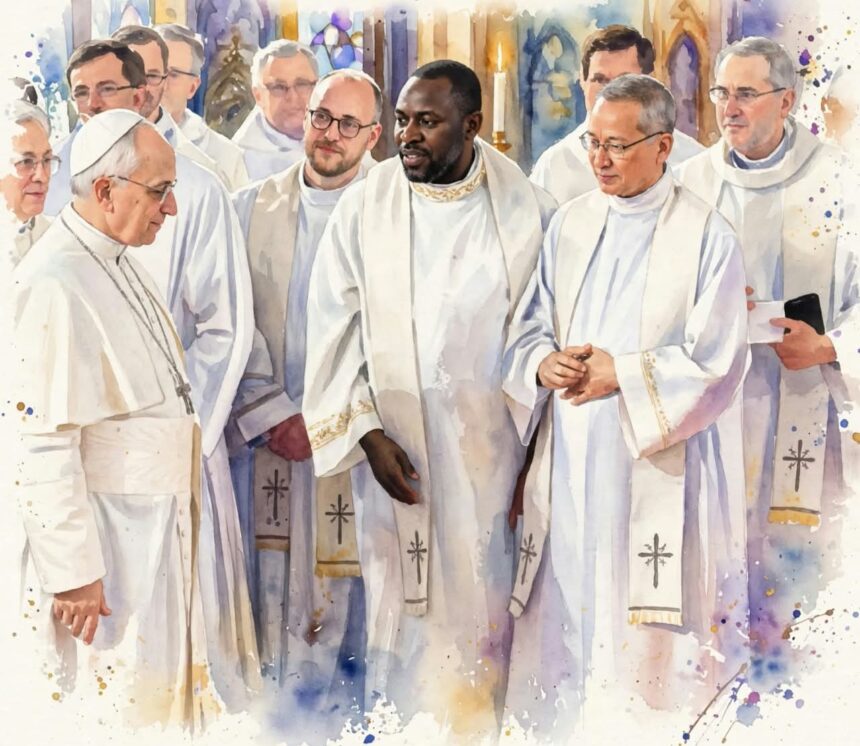
The footage is brief but striking. Pope Leo XIV approaches a Black priest who appears ready to greet him. He hesitates then turns away without the expected handshake.
Watching those few seconds alone it is difficult not to wonder why.
Was it deliberate? Was he distracted? Was there a protocol issue? Or are we simply watching a few seconds of an encounter stripped of its wider context?
My first instinct was to ask the uncomfortable question: was the priest snubbed because of his race?
That question is understandable. But it also deserves an answer based on evidence rather than emotion.
The longer footage complicates the picture.
The fact-checking team at French broadcaster TF1 reviewed the full recording of Pope Leo XIV’s visit to Metz, France on 28 September 2026. The footage shows the Pope greeting a number of people along the route including Black members of the clergy. Around the controversial moment Diego Ravelli the Master of Pontifical Liturgical Celebrations approaches the Pope and appears to say something to him. The Pope then turns towards officials standing behind him.
One explanation is that Ravelli was reminding the Pope of protocol. TF1 reported that a source familiar with the organisation of papal Masses said the Pope was expected to greet officials before proceeding to the clergy.
But there is an important qualification.
We cannot hear what Ravelli actually said.
And when TF1 published its fact-check the Vatican had not confirmed its interpretation. So while the protocol explanation is plausible and supported by the wider footage it remains an explanation of what happened rather than a direct account from those involved.
That is why I would not dismiss the question entirely.
Why did the intervention come at that particular moment? Why just as the Black priest appeared ready for his turn did the Pope’s attention suddenly change?
Those are legitimate questions.
But legitimate questions are not the same thing as proven accusations.
The wider footage shows Pope Leo greeting other Black clergy and other people along the same route. That does not tell us what was in his mind at the precise moment he missed this particular handshake. It does however make the claim of deliberate racial discrimination considerably less certain than the short viral clip suggests.
And this is where social media deserves some scrutiny.
A few seconds can create a powerful impression. The shorter the clip the easier it becomes to fill the missing seconds with our own assumptions. Once anger takes hold the fuller footage often arrives too late to change the original narrative.
Yet we should not pretend that racial prejudice is an imaginary concern. It is not. A Black priest apparently being passed over by the Pope can understandably provoke questions particularly among people who have experienced discrimination or have seen others endure it.
But discomfort is not proof of motive.
Neither is suspicion a verdict.
For me the fairest position is therefore neither to defend the Pope blindly nor to condemn him prematurely.
Ask the question. Watch the whole footage. Examine the circumstances. Then let the evidence speak.
If the priest was deliberately ignored because of the colour of his skin that would be deeply troubling. But if the Pope was genuinely redirected by protocol at that moment then accusing him of racism without establishing his intention would itself be unfair.
Perhaps the most important lesson is not about a handshake at all. It is about how quickly we judge a person from a moment we have not fully understood.
Scripture warns against judging hastily and reminds us that God alone sees the heart. As Christians who profess to worship one God we should therefore be especially careful about claiming to know another person’s motives from a few seconds of video.
I still have questions.
The hesitation is real. The missed handshake is real. The intervention by a member of the papal delegation is also visible in the fuller footage.
What remains uncertain is why.
And perhaps that is where intellectual honesty begins.
Sometimes the most honest answer is not ‘I know what happened’ but:
‘I want to understand what happened before I judge.’
Okiwelu Azed P. writes from Asaba.