

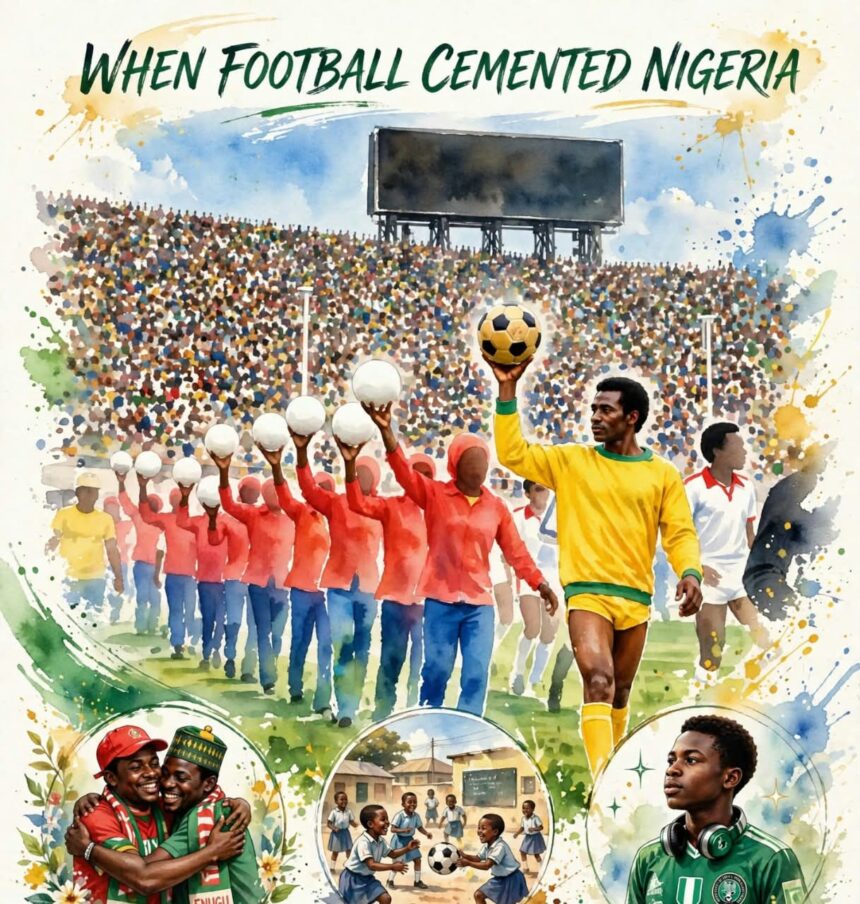
WHEN FOOTBALL CEMENTED NIGERIA
The game we loved, the excitement it created and why we cannot afford to lose one of our greatest unifying assets
I have never had the flair for football as many men do. I cannot spend hours debating formations, arguing over transfers or reciting players’ statistics from memory. But I enjoy football.
Whenever the Super Eagles play, I watch. I feel the tension when the game is close and the excitement when Nigeria scores. I may not know everything about the game but I understand what it means to millions of Nigerians.
Football was once more than a game in this country. It was a shared experience that brought people together in ways our politicians could only dream of. It gave us heroes to celebrate, rivalries to enjoy and something to talk about beyond the familiar arguments over tribe, religion and politics. For a few hours, being Nigerian was enough.
I remember when our domestic football commanded genuine excitement. You did not have to follow Manchester United, Arsenal, Liverpool or Real Madrid to enjoy a good match. Our local clubs had their own identities, their own supporters and their own heroes. People followed them with a loyalty that was not manufactured by television advertisements or social media campaigns. It grew from the communities they represented and the pride they inspired.
One match that remains memorable in the history of Nigerian football was the 1978 Challenge Cup Final between Bendel Insurance and Enugu Rangers at the National Stadium in Surulere, Lagos. Rangers were no ordinary opponents. They had won the Challenge Cup in 1974, 1975 and 1976 and had gone on to win the African Cup Winners’ Cup in 1977. They were a formidable side featuring players such as Christian Chukwu, Emmanuel Okala, Aloy Atuegbu and Patrick Ekeji.
Yet Bendel Insurance, under coach Alabi Aisien, rose to the occasion and won 3–0. With players such as Kadiri Ikhana, Peter Egharevba, Henry Ogboe, George Omokaro and Francis Monidafe, Insurance demonstrated that a well-organised team could overcome even the most celebrated opposition.
The contest was not merely about the final score. It was a clash of football philosophies. Rangers were known for their direct approach, popularly described as ‘Native Law and Custom’, while Insurance relied more on movement, passing and keeping the ball on the ground. It was a contest that gave spectators something to discuss long after the final whistle.
Insurance went on to win the league title in 1979 and the Challenge Cup again in 1980. Rangers, however, had their answer in 1981, defeating Insurance 2–0 in the Challenge Cup Final. These were not just results recorded in the pages of sporting history. They were memories that supporters carried for years.
What made those days special was not only the quality of the football. It was the sense of belonging that came with it. A club could represent a city, a state or an entire community. People who disagreed about almost everything else could stand together on the terraces, argue over a missed chance and celebrate the same goal. The rivalry was real but it did not have to become hatred.
Football also gave young people something to look forward to. Boys gathered around radios, discussed their favourite players and imagined themselves wearing the colours of their local clubs. Some would become professional footballers. Others would become coaches, referees, sports journalists or enthusiastic supporters. The game offered aspiration, discipline and a sense of direction.
That, and much else, is what we seem to have lost.
Today, many young Nigerians can tell you the latest developments at European clubs but may struggle to name the players representing their own states. It is tempting to blame them for abandoning local football but that would be unfair. Before asking why young people do not support our domestic clubs, we should ask what kind of football we have given them to support.
Where are the well-maintained community pitches? Where are the regular school competitions that once allowed young talents to discover their abilities? Where are the properly organised local leagues that can attract families, businesses and supporters? Where is the clear pathway from the school field to the academy and from the academy to professional football?
Talent has never been Nigeria’s greatest problem. Opportunity, organisation and continuity have often been the missing links.
The consequences extend beyond sport. When young people have constructive activities, good coaching and responsible adults to guide them, they have more opportunities to develop discipline, teamwork and a sense of responsibility. Football cannot solve every social problem or keep every young person out of trouble. But a properly organised grassroots system can give many young people something worthwhile to pursue.
There is also an economic argument for taking football seriously. A functioning football industry creates work for coaches, referees, scouts, physiotherapists, sports doctors, groundsmen, administrators, journalists, photographers, broadcasters, security personnel and kit suppliers. It supports transporters, food vendors and small businesses around match venues. A well-run club can become an economic asset to its community rather than a permanent burden on government.
We must stop treating football as though its only purpose is to produce eleven players who can win a match. The game is an industry, a training ground for life and a potential source of employment. With proper investment and administration, it can create opportunities for people whose names may never appear on a team sheet.
More importantly, football can help rebuild our sense of national belonging. Nigeria is a country of many ethnic groups, languages and religious traditions. Our differences are real but they need not prevent us from sharing common experiences. When the Super Eagles score, the celebration often crosses boundaries that politicians spend years trying to reinforce. The same is true when a local team gives its community a reason to rejoice.
We should not underestimate the value of such moments. A country needs more than laws and political speeches to hold its people together. It needs shared experiences and places where people can compete without becoming enemies. Football once provided many of those opportunities.
Rebuilding that culture will require more than nostalgia. Governments must invest in playing fields and school sports. Football associations must organise credible competitions. Clubs must improve their management and create genuine pathways for young players. Coaches must receive proper training and officiating must earn public confidence. Businesses should also be encouraged to invest in clubs and facilities through transparent arrangements that make commercial sense.
Communities have a role to play too. Parents, schools, traditional institutions and local organisations can help identify talent and support competitions. We do not have to wait for a national policy before a community begins to organise a football tournament. Sometimes, renewal starts with a properly marked pitch, a few committed volunteers and a competition that gives young people something to prepare for.
I would like to see a Nigeria where school football becomes exciting again, where local clubs command respect and where a young boy or girl can dream of a sporting career without having to leave the country before receiving meaningful support. I would like to see our domestic league become a competition people follow with the same enthusiasm they give foreign leagues.
If I eventually become President of the Federal Republic of Nigeria, reviving grassroots football, school competitions and community leagues would be among the priorities I would pursue. My aim would not simply be to produce better footballers but to create opportunities for our young people and restore some of the shared experiences that once brought Nigerians together.
That is the Nigeria I would want to help bring back: a country where talent is nurtured, communities are engaged and people have more reasons to stand together than to pull apart.
Perhaps what we need is not merely the revival of Nigerian football. Perhaps we need to recover the spirit that football once helped to create.
Because when football cemented Nigeria, it did more than entertain us. It reminded us that beneath our differences, we could still share a common joy.
Okiwelu Azed P. writes from Asaba.