


LET THE MGBAMKPISI BREATHE
I am yet to understand how this decision was arrived at.
More importantly, I am yet to understand the reasoning behind a sharing formula that appears capable of placing a much younger man ahead of an elderly brother simply because the younger man has taken the Alor title.
Perhaps there is a perfectly good explanation. If there is, I would genuinely like to hear it. Because the more I think about the matter, the more questions it raises about our understanding of culture, seniority, fairness and family.
The role of culture is to preserve identity, promote cohesion and transmit values from one generation to another. It should provide a sense of order, fairness and belonging. But when practices introduced in the name of modernisation begin to divide brothers and diminish the place of age and seniority, we must pause and ask ourselves: how long are we going to wait before we put things right?
People should not be compelled to take titles. In fairness, whether a man takes a title should be a matter of personal choice, guided by his circumstances, convictions and readiness. A title should be an honour one willingly embraces, not a condition for enjoying dignity or retaining one’s rightful place within the family and community.
When I was growing up, I was quite cocksure about one thing: in accordance with Asaba tradition and custom, age and seniority were respected.
To my recollection, there was nothing like the fixed and rigid ‘sharing formula’ we appear to have today, where percentages and titles can suddenly place a younger man ahead of an older man simply because the younger man has taken a title.
We knew our customs. We knew our elders. We knew who was senior to whom. We understood that seniority carried responsibility and that age was not something to be casually jettisoned whenever there was something to share.
But somewhere along the line, something appears to have changed.
A young man in his thirties or forties who has taken the Alor title can now, under the prevailing formula, take a lion’s share of a communal largesse while a man in his seventies or eighties who has remained Mgbamkpisi receives considerably less.
The disparity can be so whopping that one is compelled to ask: when did a title become powerful enough to cancel age?
This ‘formula’ is suffocating. It is intimidating and, in some circumstances, simply unfair to people who have spent decades contributing to their families and communities but, for one reason or another, never took the Alor title.
More troubling is the extent to which this sharing formula appears to be finding its way into family and communal inheritances left behind by our fathers and forefathers.
Traditionally, where family property was being shared, there was room for fairness and consideration of age and seniority. The property could be shared according to an agreed basis — ịlalo — with something extra taking account of seniority, responsibility and the position of the Okpala or Diokpa.
The essence was not necessarily to make the eldest the richest person in the family but to recognise his place and the responsibility attached to it.
Now imagine a man in his mid-thirties who has just taken a title being allowed to select the choice portion of family property ahead of an elder in his seventies simply because the sharing formula favours him.
What does that do to the old man’s dignity?
What does it tell the younger generation about respect?
And what message does it send to the Mgbamkpisi who may have contributed to the family in ways that money and titles cannot measure?
It reminds me of an image that is painfully simple.
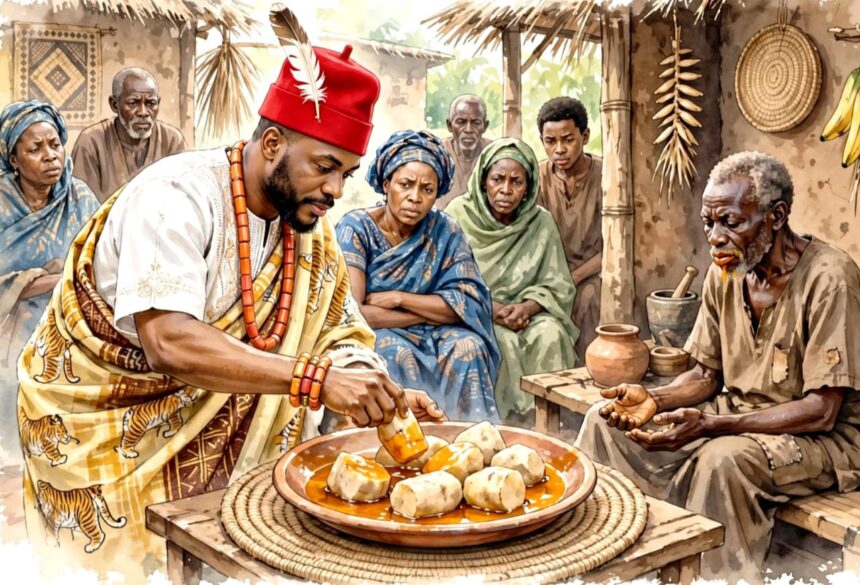
It is like one person dipping his piece of yam generously into a plate of palm oil while another merely has the palm oil rubbed on his lips. To anyone watching from a distance, both appear to be partaking of yam and palm oil. But only one is actually eating.
That is not meaningful sharing. It is creating the appearance of participation while quietly denying another person the substance.
There is a reason our elders said: ‘Okpala ka Eze.’
The firstborn was not necessarily the richest, the most educated, the strongest or even the most successful. Yet he had a place. With that place came responsibility.
In the traditional family structure, the Okpala or Diokpa was expected to stand in for the father when the father was no longer there. He represented the family. He helped settle disputes. He was expected to protect the interests of his siblings and preserve the family name.
That position was not simply a licence to grab the biggest piece of meat at the table.
It was a burden of responsibility.
This is why ‘Okpala ka Eze’ cannot simply be glossed over as an outdated saying that has become irrelevant because society is changing. Modernisation is not supposed to mean cultural amnesia.
Our culture can evolve without losing its moral foundations.
We must also distinguish between respecting seniority and abusing seniority. They are not the same thing. Seniority should not be used to oppress younger members of the family. But neither should equality be interpreted to mean that age, birth order and responsibility no longer matter.
There must be balance.
Across cultures elders are respected because they represent continuity. As Africans we have traditionally honoured our elders not merely because they are wealthy or successful but because they have lived long enough to acquire experience, wisdom and a deeper understanding of life.
Many Western societies too recognise the value of age and respect their elders irrespective of wealth, achievement or social status. A younger person being richer or more accomplished does not automatically make an elderly person less worthy of respect.
Even the biblical story of Esau and Jacob reminds us of the seriousness traditionally attached to birthright. Esau, though a twin, was recognised as the firstborn but eventually sold his birthright for food. The story has many religious interpretations but it nevertheless illustrates how seriously birthright and seniority were regarded in ancient society.
Across many cultures, elders are respected because they represent continuity. They remember where the family came from. They know who married whom. They remember the boundaries of ancestral land. They know the stories behind the names we proudly carry today. They remember disputes that younger people have forgotten and sometimes the sacrifices that made it possible for those younger people to stand where they are standing.
You cannot replace all of that with a percentage table.
Sadly, there is also an emerging tendency to judge brothers by what they wear, what they drive and what they can afford.
The man in expensive clothes commands attention. The man who arrives in a big vehicle is treated differently. Meanwhile, an elderly relative in an old shirt may be quietly overlooked.
But clothes do not always tell the story of the wearer.
A fine shirt can hide a troubled life. A new car can conceal debt. A modest appearance can conceal decades of sacrifice.
Money can change a man’s surroundings but it should never change his heart.
Success can change a person’s circumstances but it should never erase humility.
And taking a title should make a man more responsible, not more entitled.
Indeed, if anything, the Mkpalor should be the first to recognise and protect the dignity of the elderly Mgbamkpisi among them.
The greatest danger of this sharing formula, therefore, is not the percentage itself.
It is what the percentage can do to relationships.
It can subtly tell your brother, the Mgbamkpisi: ‘Go away. Don’t join us. We don’t have anything to do with you until you take your Alor title.’
If that is not the intention, then we must examine the outcome. Because sometimes what matters is not merely what a system was intended to achieve but what it actually produces.
When an elder repeatedly feels humiliated or short-changed, he may eventually withdraw from family affairs. He may stop attending meetings. He may stop contributing to family projects. He may decide that if his own family no longer considers him important, he should keep whatever little he has to himself.
And sometimes the elderly man does not protest.
He simply keeps quiet.
But silence does not necessarily mean acceptance. Sometimes silence is the wounded man’s way of preserving the little dignity he has left.
When such grievances accumulate, families begin to develop invisible walls. Brothers who once ate from the same plate stop visiting one another. Information is withheld. Contributions become suspicious. Family meetings become battlegrounds. People begin keeping their resources to themselves.
Eventually, a family that once functioned as one household becomes a collection of individuals who merely happen to share a surname.
Is that what we want?
Our expression Usọ dị na nsota li captures something fundamental about communal life: there is strength in togetherness.
Family fellowship is supposed to be communal, all-encompassing and all-embracing.
The wealthy brother has a responsibility towards the struggling brother.
The younger brother has a responsibility towards the elder.
The title-holder has a responsibility towards the untitled.
And the elder has a responsibility to guide without abusing his seniority.
That is how fellowship survives.
This is not a campaign against the Mkpalor.
It is a plea for the Mgbamkpisi.
Let the man who has not taken the title breathe.
Let him sit at the family table without feeling inferior.
Let his age count.
Let his contribution count.
Let his relationship with the family count.
Let his humanity count.
A man’s decision not to take a title should not suddenly turn him into a second-class brother.
And this is where I believe we need to reconsider the sharing formula, particularly when family inheritance is involved.
There is a difference between communal largesse and family inheritance.
A community may legitimately agree on how a particular communal resource should be distributed. But where property belongs to a family and was built, acquired or left behind by fathers and forefathers, we should be careful about imposing a system that effectively erodes the family’s established principles of seniority and responsibility.
Let us not forget that our fathers may have spent years building those shops, houses, farms and other properties. Some may have contributed money. Others contributed labour. Some made sacrifices that nobody recorded. Some went without so that the family could acquire what it now has.
When the children and grandchildren eventually share such property, should a formula created later simply wipe away all those considerations?
I think we need to have an honest conversation about this.
And that conversation should not be interpreted as an attack on the Alor title.
I love our culture. I respect our traditions. I believe titles have their place.
But the essence of a title should be honour, responsibility and service.
It should not become an automatic passport to a larger share of family wealth.
Nor should people be compelled to take titles simply because they want to retain their place in the family or avoid being disadvantaged during sharing.
If taking a title is genuinely an honour, let people take it willingly.
If it is a responsibility, let those who accept it demonstrate the responsibility.
But let us not create a system in which a man must first acquire a title before he can be treated with dignity by his own brothers.
Modernisation should improve our traditions; it should not bulldoze them.
The mentality of ‘Let’s be like others’ is not enough reason to abandon what has worked for us through the years. Asaba culture and tradition should not be replaced simply because another society does things differently.
People respect us when we know who we are.
They respect us when our customs are understood.
They respect us when our traditions are practised with consistency, fairness and dignity.
Let us not make a mockery of it.
If something in our tradition needs adjustment, let us discuss it.
If a practice is producing resentment, let us examine it.
If the Alor title is being interpreted in a way that creates unintended divisions among brothers, let us have the courage to correct it.
But let us not confuse every new practice with progress.
Perhaps it is time to return to the original requirements and values surrounding the conferment of the Alor title and ask ourselves what it was really intended to achieve.
Was it meant to make a man superior to his elder brother?
Was it meant to give a younger man an automatic right to choose the best portion of family property?
Was it meant to turn wealth into social rank?
Or was it meant to recognise achievement while placing greater responsibility on the person honoured?
These are not unreasonable questions.
Once a title becomes an instrument for acquiring material advantage at the expense of family harmony, we have moved away from honour and entered the territory of entitlement.
And entitlement can destroy a family faster than poverty.
We should be able to celebrate our Mkpalor without humiliating our Mgbamkpisi.
We should be able to recognise achievement without insulting age.
We should be able to modernise without destroying the foundations that held our families together.
Most importantly, we must remember this:
A title is acquired; age is lived.
A title can be conferred in a day.
Seventy or eighty years of life cannot be conferred by anybody.
A title can decorate a man’s name.
It cannot replace the years he has lived.
So, when next we gather to share something among ourselves, let us pause before the percentage table takes over.
Let us look around the room.
Look at the old man sitting quietly in the corner.
Look at the brother who could not afford the title.
Look at the elder whose clothes no longer announce his importance.
Look at those whose shoulders carried this family before some of us were born.
Then ask ourselves a simple question:
Are we sharing wealth or are we sharing dignity?
We can do one without destroying the other.
But if our new formula leaves some brothers permanently standing outside the circle, then something is wrong.
We must object.
We must speak.
We must insist on a fairer balance.
And perhaps most importantly, we must return to the values that made ‘Okpala ka Eze’ meaningful in the first place.
It was never meant to be a relic of a forgotten age. It was a reminder that seniority carries responsibility and that a family survives not merely by sharing property but by sharing dignity.
It is time to reverse course.
It is time to restore balance.
It is time to restore the place of age and seniority without diminishing the achievements of the younger generation.
And above all:
LET THE MGBAMKPISI BREATHE.
Okiwelu Azed P. writes from Asaba.