

I WANT TO BE PRESIDENT
For as long as I can remember, I have nursed this ambition. With humility and a deep sense of responsibility, I want to be President of the Federal Republic of Nigeria. I am dead serious about this.
Not for the title, the convoy, the sirens or the privilege of occupying Aso Rock. I want to lead a Nigeria its citizens can once again be proud to call home.
Everyone wants to move forward. Nobody prays to go backwards. Yet looking at where we are today, one cannot help wondering whether there are things in our past worth recovering.
I recently watched a documentary about an abandoned tomato factory. I stared at the ruins and sighed.
What a monumental waste — a nation of displaced priorities.
Then I discovered something that took me straight down memory lane: Vegfru tomato paste was made in Nigeria. I honestly did not know that.
And remembering the Nigeria of my childhood inevitably raises a question: where did we lose our way?
There was a time when everything around us did not come with a foreign accent.
You walked into a Nigerian home and saw Thermocool refrigerators doing their duty. You listened to the news on locally assembled radios, watched television on locally assembled sets and saw Peugeot 504s and 404s on the road, built in Kaduna.
There were Volkswagen cars and buses assembled here too — including the famous Beetle, with its slogan: ‘There’s no killing the Beetle.’
There were Dunlop and Michelin tyres, Exide batteries, textile mills and factories producing household goods and employing Nigerians.
Then came the familiar products of childhood: Joy Soap, Key Soap, Omo, Elephant and Surf detergents, Astral cream, Nku cream and Dan Fulani pomade. There were biscuits and sweets — Hacks, Trebor, peppermints and other treats that disappeared from the house faster than anyone could explain.
Nobody needed to tell us where these products came from. They were part of our lives.
Nigeria made things.
We had factories, engineers, technicians and mechanics who could strip an engine down and put it back together. Young people learnt trades. Men and women went to work each morning knowing their hands helped produce something another Nigerian would use.
Even our roads told the story:
Peugeot from Kaduna.
Volkswagen from Lagos.
ANAMMCO trucks from Enugu.
Leyland buses from Ibadan.
Dunlop tyres from Lagos.
Michelin from Port Harcourt.
These were not merely company names. They were part of our national story.
And then there was Nigeria Airways.
Ah, Nigeria Airways!
Those words once carried meaning. We had a national airline and industrial ambition. We believed Nigeria could manufacture, assemble, build and compete.
So, what happened?
How did we move from ‘Made in Nigeria’ to ‘How much is it in dollars?’
How did we become a country that exports raw materials and imports finished products made from them? How did we allow factories to die while importing the very goods they were built to produce?
That is what pains me.
When a factory closes, it is not just a building that disappears. Jobs, skills and apprenticeships disappear. Suppliers lose business. Communities lose income. Eventually, a generation grows up believing that anything good must come from abroad.
We did not merely lose factories. We lost a mindset — the belief that we could make things here.
I want to restore that mindset.
And I want to build Nigeria around a simple idea: comparative advantage.
Every part of Nigeria has something to contribute.
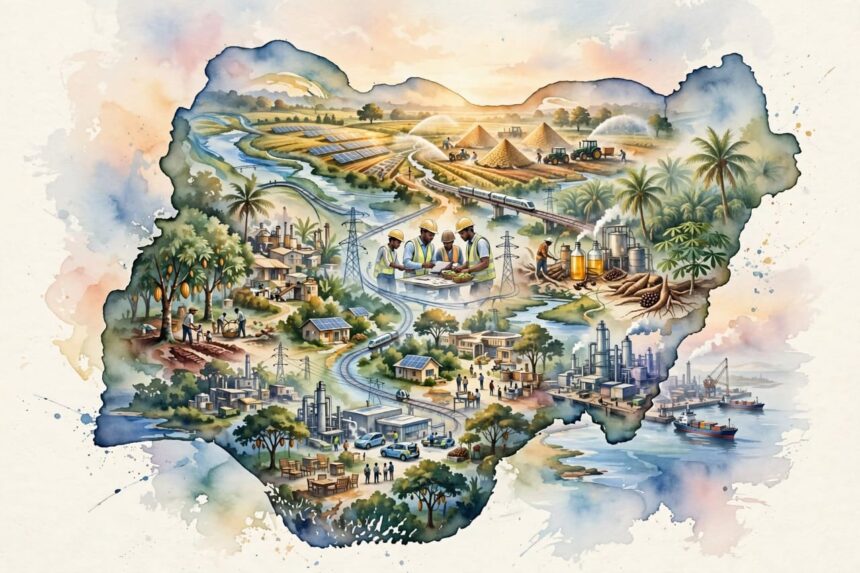
The East has oil palm, cassava and a long tradition of enterprise. Let us build modern processing industries around these strengths, producing vegetable oils, cosmetics, food ingredients and other finished goods.
The West has cocoa. Let us process it into chocolate, beverages, cocoa butter and powder while building Nigerian brands that can compete globally.
The North once gave us the magnificent groundnut pyramids. Let us restore that agricultural confidence through modern farming, irrigation, mechanisation, storage and processing. The North can become a major food and agro-industrial powerhouse.
The South-South has rubber, timber, oil and gas and other natural resources. Let us stop merely exporting raw materials. Let us make tyres and other products from rubber, process timber into plywood and furniture and move beyond crude oil into refining, petrochemicals, fertiliser and other value-added industries.
This is the Nigeria I dream of: one where every region develops its strengths and contributes to a single national economy.
The farmer connects to the factory.
The factory connects to the market.
The university connects to research.
Research connects to industry.
The young person connects to skills.
And the entire chain connects to electricity, roads, rail, ports and security.
That is how an economy breathes.
But I want us to think beyond the energy system we inherited.
I want Nigerian homes increasingly powered by technologies suited to their locations — solar, battery storage and, where viable, wind and other renewable sources.
Why should the sun that shines so generously on Nigeria merely heat our roofs when it could also power our homes?
I want Nigerian engineers and manufacturers producing more of the solar panels, batteries, inverters and other components we need.
I also want us to rethink transportation.
Imagine Nigerian companies manufacturing electric vehicles, buses and tricycles at scale, supported by charging infrastructure across our cities and highways. Imagine our engineers developing batteries and other components here.
I would encourage serious research into hydrogen-powered transport and other emerging technologies where they make technical and economic sense.
The goal is simple: reduce our dependence on petrol, ease pressure on household incomes and build new Nigerian industries.
Today, we complain about unemployment, inflation, foreign exchange shortages and the rising cost of imported goods. Yet our past is filled with factories and skilled Nigerians who proved that another Nigeria was possible.
That is why Vegfru struck me so deeply.
It is not merely about one product or one abandoned factory. It is a window into a Nigeria many younger Nigerians never knew — a country that produced, assembled, employed and built; a country that, despite its problems, believed in itself.
Where did that Nigeria go?
Perhaps the bigger question is whether we have the courage and imagination to recover what was good about it while leaving behind what held it back.
That is where my presidential ambition comes in.
I want a Nigeria where factories are not abandoned monuments. Where our raw materials feed our industries before being shipped abroad. Where ‘Made in Nigeria’ is not merely a slogan but something we encounter every day in our homes, markets, roads and workplaces.
I want the East to prosper from its agricultural and entrepreneurial strengths, the West to turn cocoa into global products, the North to reclaim its place as an agro-industrial powerhouse and the South-South to build industries around rubber, timber, petrochemicals and other resources.
I want these regions connected rather than permanently quarrelling over who gets the bigger slice of the national cake or depending solely on allocations from Abuja.
Comparative advantage should not mean comparative isolation.
The East should sell to the North.
The North should sell to the West.
The West should sell to the South.
The South should sell to the East.
And all of us should sell to the world.
We should stop asking only how to share the national cake. We should ask how to make it bigger.
How do we produce more? Process more? Employ more? Export more finished products? Create wealth that does not depend entirely on government sharing?
That is the Nigeria I want.
Perhaps it is an old-fashioned dream. But I would rather dream of factories than abandoned factories, production than importation and opportunity than desperation.
I want Nigerian engineers designing the machines our factories use. I want Nigerian farmers supplying those factories and Nigerian manufacturers competing in African and global markets.
I want Nigerian scientists solving Nigerian problems, Nigerian homes generating clean energy and Nigerian companies building the vehicles of tomorrow.
Above all, I want our children to grow up knowing that the things around them can be made by people who live in the same country they do.
I want to be President.
And if I ever get there, I do not want my presidency remembered for the size of my convoy or the number of people standing behind me.
I want Nigerians to point at a factory, a farm, a solar-powered home, a Nigerian-made vehicle or a product on a foreign shelf and say:
‘This was made here.’
Because I do not believe Nigeria was incapable.
I believe we lost our way.
And perhaps we can still find it.
If only I become President.
Okiwelu Azed P. writes from Asaba .