


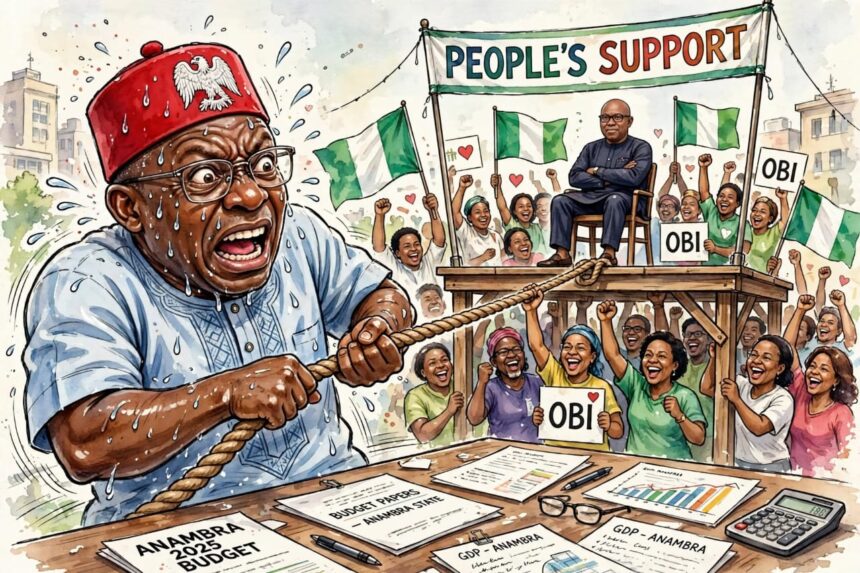
PROFESSOR, DON’T TEACH US NONSENSE
I must confess that I find the continuing hostility between Professor Chukwuma Soludo and Peter Obi deeply uncomfortable.
Not because Peter Obi should be above scrutiny. He is not. As a former governor, his record can and should be examined. Public office is not a family compound where everybody agrees to keep quiet when the account book is opened.
What troubles me is the intensity and persistence of the quarrel.
Here is a professor — a man whose intellectual authority commands respect — repeatedly revisiting the record of a former governor who is now enjoying considerable political support outside Anambra.
And I keep asking myself: Professor, what exactly are we still looking for?
Are we conducting an audit or excavating an archaeological site?
There is something called authoritative knowledge. In simple English, it is knowledge we tend to accept because it comes from somebody we regard as an authority.
Professor says it, so it must be correct.
The lawyer says it, especially when ‘SAN’ follows the name, and suddenly everybody sits up.
The priest says it, the traditional ruler says it, the general says it and the expert says it — and many people promptly put their thinking caps on the table.
The words of authority begin to sound as if they arrived with a manufacturer’s warranty.
But that is where we must be careful.
A professor is a professor, not a prophet.
An authority can command attention but evidence must earn belief.
A student may read something in a textbook and conclude: ‘Professor wrote it, therefore it cannot be wrong.’
My friend, calm down.
Even professors can disagree. Even professors can make mistakes. And even professors must produce evidence when making factual claims.
That brings us to Professor Soludo and his continuing dispute with Peter Obi over what the former governor left behind in Anambra.
This is not a new disagreement. In November 2022, Soludo said Obi’s purported investments were worth ‘next to nothing’. Yet in another public appearance that same month, Soludo also spoke of Obi’s prudence and said he was taking that prudence to the next level.
So nobody should pretend there has never been a change in tone.
Today, however, the argument has entered another round. The Anambra Government says it has records showing debts incurred under previous administrations, including Obi’s. Obi disputes the claims and has challenged the Soludo administration to prove that he left Anambra owing the debts being attributed to him.
The government has since released documents in support of its position while Obi’s former SSG, Oseloka Obaze, has also presented a different account of what was left in the state’s coffers.
So, there we are.
Bring the books.
Not the professor’s title.
Not the political speeches.
Not the grammar.
Not the intellectual fireworks.
Bring the documents.
If there were debts, show us the loan agreements, repayment schedules and certified records.
If there were unpaid obligations, show us the records.
If there were savings, investments and balances left behind, show us those records too.
Let the documents fight.
Let the figures argue.
Let the auditors settle the quarrel.
Because ₦1 does not become ₦2 simply because a professor says it with confidence. Neither does ₦2 become ₦1 because a politician says so.
And this is where I believe Ndigbo must be mature enough to separate brotherhood from blind loyalty and politics from evidence.
I find it particularly painful when people who have benefited from the goodwill and support of their fellow Igbo later appear to spend considerable energy pulling down another Igbo man who has become popular beyond the shores of Anambra.
Soludo has every right to disagree with Obi. He has every right to criticise his record. But there is still room for restraint, civility and the recognition that political disagreement should not become a permanent family quarrel.
After all, Peter Obi himself once described Soludo as his brother and said he remained prayerful for him.
That should count for something.
Fela Anikulapo-Kuti had the perfect line for situations like this:
‘Teacher, don’t teach me nonsense.’
It was never an insult to education. It was a warning against accepting authority without questioning what comes out of the mouth of the authority figure.
So, Professor, teach us.
Explain the figures.
Show us the records.
Take us through the evidence.
But please, don’t ask Nigerians to accept a conclusion merely because it comes wrapped in the authority of a professor.
We are listening.
We are reading.
And these days, Professor, we are checking the books too.
Perhaps what we need now is not a tabula rasa — a blank slate — but a clean table, with all the documents placed on it.
Then let the evidence speak.
Okiwelu Azed P. writes from Asaba