


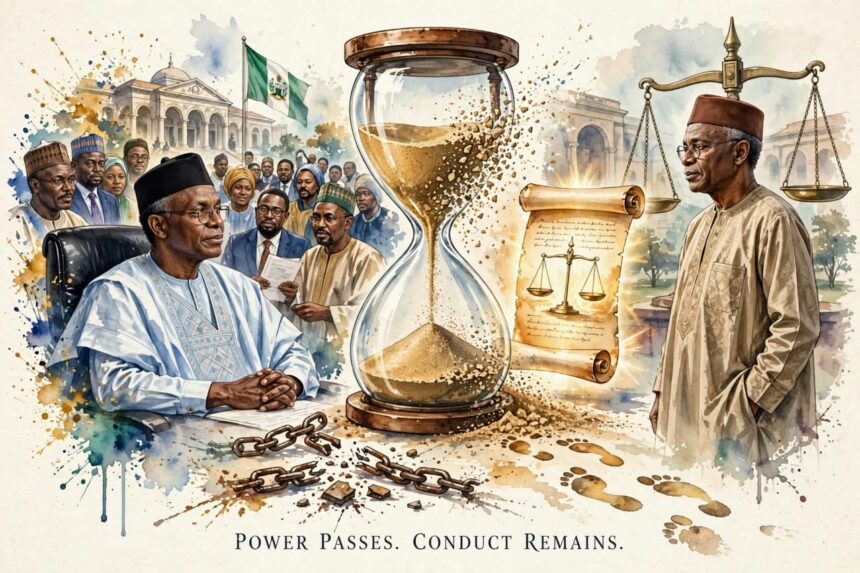
POWER PASSES. CONDUCT REMAINS
Public office is temporary, but the record of how power is used can outlive the office itself.
People tend to abandon the truth when it becomes inconvenient. Standing by it can cost them comfort, friendships or political favour, so silence often feels easier, especially when someone they once backed is in trouble. But life has a way of bringing people full circle, and yesterday’s powerful man can find himself where those who felt ignored or mistreated once stood.
Nasir El-Rufai has reportedly complained that many allies have deserted him in his present ordeal.
It is a painful discovery, but a familiar one in public life. Power draws crowds, while losing it reveals who was there for you and who was there for the position.
Still, his situation raises a bigger question: how did a man who wielded such enormous political authority end up in circumstances that echo those of some of his former critics?
The answer is difficult to separate from his record as Kaduna State governor between 2015 and 2023. His administration drew sustained criticism over its handling of opposition, civil liberties and the rule of law. Critics accused him of using the machinery of government to intimidate opponents and silence dissent.
One frequently cited example is Maina Joseph, a Leadership newspaper journalist who was reportedly arrested and detained after writing critically about the then governor. Cases such as this fuelled concerns about press freedom in the state.
Every public office holder should understand that government is not a personal possession. The authority entrusted to a governor or public official is temporary and comes with one fundamental purpose: to serve the people. It is not a licence to punish critics or humiliate those who disagree.
Leadership calls for restraint, humility and respect for the rights of others.
The rule of law must be non-negotiable, especially for those who wield state power.
Court orders are not suggestions to be honoured only when convenient. They are binding obligations, regardless of an official’s personal feelings or political interests.
Yet many politicians seem to forget this once they taste power. They mistake authority for supremacy and criticism for hostility, and they begin to treat public institutions as tools of control rather than safeguards of democracy. Each time that happens, public trust erodes and a dangerous precedent takes root: that power exists to settle personal scores.
None of this is a call to celebrate El-Rufai’s troubles. Nobody deserves persecution, injustice or the denial of fundamental rights, whatever their past conduct. His experience should prompt reflection, not applause.
But fairness cuts both ways. Those who felt the weight of power in the Kaduna Government House should not be brushed aside simply because the political winds have shifted. The principles that protect El-Rufai today should have protected his critics yesterday.
Human rights cannot depend on party membership and the rule of law cannot be defended selectively. Justice must be impartial, whether it concerns a former governor, a journalist, a political opponent or an ordinary citizen.
So, to everyone holding public office: remember why you are there. Listen to criticism. Respect the courts. Protect the rights of your opponents. The people you can hurt today may one day occupy positions where your own rights depend on the fairness of the system.
Influence fades, friends drift away and circumstances change. What lasts is the record of how power was used. Public office is a passing privilege, but how you treat the people is the legacy that endures.
Okiwelu Azed P. writes from Asaba.