


All’s Not Fair: Why 2027 Should Worry Every Nigerian
I am beginning to worry about 2027.
Not because elections are new to Nigerians — we know politics can be rough, noisy and even shameless. What worries me is something more fundamental: the growing impression that some of those who control the machinery of power no longer see fairness as a necessary ingredient of democracy.
I hope I am wrong. But hope should not make us blind to warning signs.
One statement keeps returning to me: President Bola Tinubu’s reported assertion that ‘all is fair in politics’. That sentence bothers me. Politics already tempts people to stretch the rules. Once ‘all is fair’ becomes the operating political philosophy, almost anything can be dressed up as strategy — intimidation as mobilisation, patronage as politics, manipulation as cleverness. Victory becomes the only thing that matters.
History counsels caution here. During the civil war, Obafemi Awolowo defended the economic blockade against Biafra with similar logic. Whatever one’s position on the war, the suffering that followed was real — children starved, families suffered, ordinary people paid for decisions they did not make. That is the danger of political language: a phrase uttered casually by those in power can become a licence for reckless behaviour below them.
We have watched this movie before. Ahead of 2023, Nigerians heard that power was not something ‘served on a platter’. It was framed as toughness but many heard something else: power must be taken by any means necessary — grabbed it, snatched it, run with it.
Now similar language is resurfacing. An official talks of who the President would send to ‘handle’ a state. A cleric openly campaigns for a Muslim-Muslim ticket. A politician tells residents to choose APC or leave. In Borno, a commissioner was reportedly accused of threatening violence against those who withheld support from the ruling side. Elsewhere, a governor reportedly warned local government chairmen that losing elections could cost them their positions.
Perhaps each incident can be explained away — that is precisely the problem. Treat every warning sign as isolated and we miss the pattern. And the pattern is becoming increasingly difficult to ignore.
What happened to the simple idea that voters are free to choose? When did disagreement become disloyalty? When did public office become a tool for rewarding friends and punishing dissenters?
An election should not leave citizens wondering whether voting for the wrong candidate could cost them their job, their contract or their place at the table. That is not democracy — that is intimidation wearing a democratic shirt.
Then there is the electoral system itself. Credibility cannot be manufactured with speeches and press conferences. Look at the controversies surrounding party primaries — even uncontested ones have produced disputed figures and questionable procedures. If a party cannot conduct a primary cleanly without a serious opponent in the race, what should Nigerians expect when the presidency is at stake?
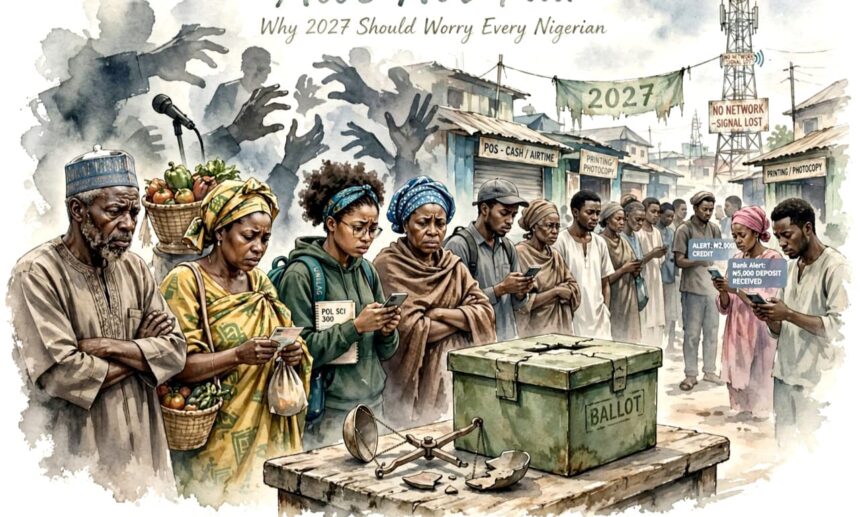
And then there is electronic transmission of results. For years we’ve heard about the ‘difficulties’ — some lawmakers even claimed there was ‘no network’ in their villages. That’s hard to swallow in a country where people living in communities with terrible roads receive bank alerts, farmers move money by phone and young Nigerians run businesses online. Something does not add up.
My biggest concern remains INEC. The 2023 election exposed serious weaknesses around technology and result transmission; public trust took a beating. As we approach another presidential election, Nigerians are entitled to ask: what has actually changed? Who was held responsible? What systems were overhauled? What safeguards exist now? What happens if the technology fails again — and who answers for it?
These are not opposition questions. They are citizens’ questions.
INEC belongs to the Nigerian people — not to the ruling party, not to the opposition. That distinction must never blur.
I am not predicting that 2027 will be rigged, nor am I saying the outcome has already been decided.
I am saying something simpler: we should not wait until election day to start worrying about the integrity of the election. By then it may be too late.
A credible election requires preparation long before voters queue at polling units: transparent procedures, competent officials, credible technology, accessible results and real consequences for those who deliberately undermine the process. Most of all, it requires citizens willing to ask uncomfortable questions.
‘Power is not served on a platter’ should not become an excuse for political desperation. Neither should ‘all is fair in politics’ become a moral blank cheque. There must be limits. There must be rules. There must be consequences. And there must be a point where political ambition stops and the country’s interests begin.
I want 2027 to prove my instincts wrong. I want Nigerians to vote freely and confidently, with every legitimate vote counted — losers accepting defeat because the process was credible, winners celebrating because they genuinely earned the mandate.
But that kind of election will not happen because we wish for it. It will happen because Nigerians insist on it. The pressure must begin now — from civil society, the media, professional bodies, political parties and above all citizens who refuse to surrender their democracy to political gladiators.
We have been told that power is not served on a platter. Fine. But neither should democracy be served on a chopping board. If ‘all is fair in politics’ becomes the excuse for every shortcut, every threat, every manipulation, then 2027 may become another election in which the political class counts the gains while ordinary Nigerians count the cost.
That is why I am worried. And perhaps we all should be.
Okiwelu Azed P. writes from Asaba.