


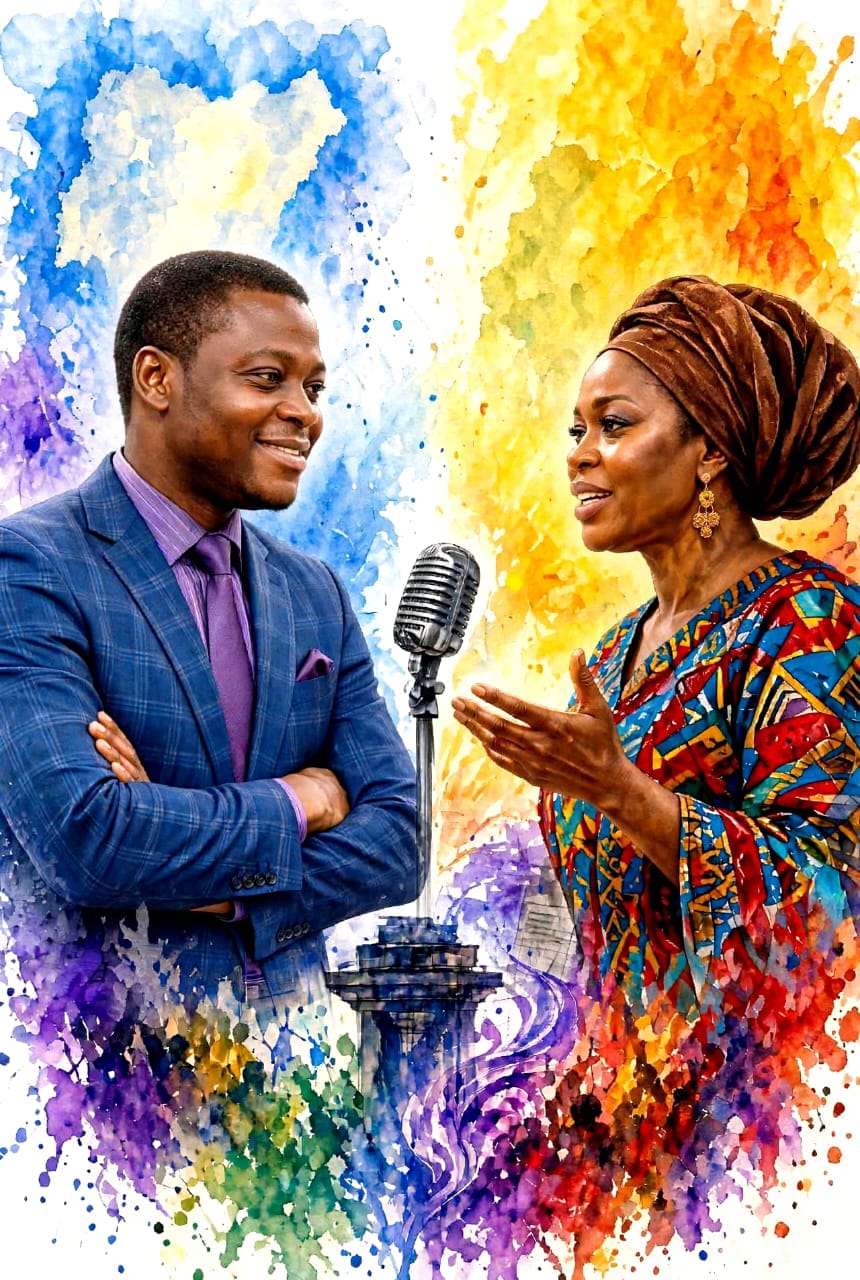
RUFAI OSENI AND ABIKE DABIRI-EREWA: TWO MEDIA PERSONALITIES, TWO PUBLIC JOURNEYS
When journalists dig, it’s questions that matter, and the evidence supporting them
The spat between Rufai Oseni and Abike Dabiri-Erewa is revealing not just of contrasting personalities but of fundamental questions about the public’s judgment of journalists who have dared to ask hard questions and of journalists-turned-public-officials who answer them.
Both individuals know well the power of the microphone, but the manner in which they have been received is revealing of the difference made by the type of authority wielded by power-wielders as opposed to that exercised by answerers.
Dabiri-Erewa, formerly of television journalism and now in public office, has shifted the context of judgment: while as a journalist she asked questions, as a public official she must answer them.
Rufai, a co-host of The Morning Show on Arise Television, has made a name for himself through his combative style as a journalist. However, while Dabiri-Erewa has moved from journalism to governance, Rufai has remained in the news in his capacity as a journalist, asking hard questions of public officials.
Neither approach is inherently better than the other. Journalism can contribute positively to governance and former journalists can make positive contributions to public life, but the responsibility for fulfilling their respective roles remains a matter of individual choice.
Rufai’s combative style makes him appealing to a public that perceives its leaders as rarely accountable, while his approach serves as a reminder to those in power that they can, at any time, find themselves being grilled.
But the value of Rufai’s performance as a journalist depends to a large extent on the relevance of the questions he asks, the accuracy of the information he provides, and the illumination of the issues at hand.
Similarly, while Dabiri-Erewa’s criticisms of a decline in journalistic standards are understandable given the prevalence of misinformation, there is a question as to whether her criticism is an attempt to distract attention from legitimate questions regarding her performance as a public official.
When a political leader accuses a member of the media of unprofessionalism in response to questions he or she is unwilling to answer, the public has a right to know whether there truly was an unprofessionalism or whether there was simply a case of an official not liking the questions being asked.
It is not enough for Rufai to hold up a mirror to power. Unless the reflection he sees is accurate, he has failed as a journalist.
Similarly, unless Dabiri-Erewa answers questions regarding the potential unprofessionalism of her reaction to the social media post that was the catalyst for the spat with Rufai, she has failed as a public official.
The difference between the two individuals is partly reflected in their respective images. Rufai is seen by many as a combative broadcaster who has no qualms about asking hard questions. That combative style has earned him kudos from many Nigerians as a public official who is willing to call the powerful to account.
On the other hand, as a former journalist, Dabiri-Erewa has demonstrated publicly that she can hold her own in the media, where the primary responsibility of journalists is to ask hard questions. As a public official, she must accept that she is similarly obliged to answer hard questions.
Neither party is immune from error, but both have accepted the responsibilities of their positions, with no one owing fealty to either individual.
The spat between the two has revolved around allegations that Dabiri-Erewa has reacted with laughing emojis to a social media post that contained highly offensive remarks about Igbo people. She has maintained that she did not write the post.
It is important to note that a reaction does not make an individual responsible for what is said in a social media post, and while many Nigerians argue that an emoji can be taken as a statement, the fact remains that few take emojis as statements of fact.
However, the controversy goes deeper than the simple question of authorship of the post. It also revolves around the reasons why the post was reacted to as it was, and what such a reaction says about the person who reacted.
The issue of ethnicity is a sensitive one in Nigeria and any reaction that could reasonably be taken to be pejorative towards members of an ethnic group should be examined carefully by a public figure who is supposed to serve all Nigerians.
Rufai’s responsibility as a journalist is to report accurately on what occurred. If he got the facts wrong, he must correct them. On the other hand, if his account of events is correct, Dabiri-Erewa must be willing to answer questions about why she reacted to the social media post the way she did.
If both individuals act honourably, there should be no problem.
The spat has reflected poorly on both individuals, as well as on their supporters, who have engaged in a war of words, with each side believing itself to be in the right simply because it supports one of the individuals.
It is not enough for Rufai to be seen as a fearless critic of public officials. Unless he has facts, he must not go beyond asking questions. Similarly, while Dabiri-Erewa’s support of traditional journalism values is understandable, she cannot simply ignore questions about her conduct as a public official.
It is true that the rise of social media has done little to improve Nigeria’s love affair with misinformation, as it has made it easier for anyone with an internet connection to disseminate it. However, journalists who worked before the advent of social media have not been free of its effects, as they must now compete with the ability to publish any information instantly.
The same issues apply to both traditional journalism and social media publishing: the need for accuracy, fairness, independence, and a commitment to serving the public interest.
Journalism is not made better by being more combative than its predecessors, nor is it made worse by asking fewer hard questions. What matters is that it fulfils its role of informing the public, challenging power, and holding officials accountable.
Ultimately, the spat between Rufai and Dabiri-Erewa is a contest for supremacy between Nigerians who believe that their leaders should always answer for their actions. Rufai should not assume that his popularity gives him carte blanche to ask leading questions. While his detractors are correct to demand that he refrain from asking questions that imply negative answers, his supporters are equally correct in noting that his combative style has forced public officials to answer for their actions.
Similarly, while Dabiri-Erewa should not be judged solely on her conduct as a journalist, she cannot escape criticism for her actions as a public official by citing her years of experience as a journalist.
If Rufai got the facts wrong, he must correct them. If Dabiri-Erewa’s actions reflect negatively on her suitability for public office, she must answer those criticisms.
Nigeria needs responsible journalists who will not be cowed by powerful officials, as well as public officials who will not dismiss criticism as an assault on their credibility.
It needs citizens who can defend their preferred personalities without reneging on basic principles.
The microphone should empower the people, and not embolden the broadcaster.
The power of public office should inspire confidence, and not elicit questions about an individual’s readiness to justify his or her actions to the public.
That is the standard by which Rufai Oseni and Abike Dabiri-Erewa should be judged.
Okiwelu Azed P. writes from Asaba.