

Silence Speaks Too Loudly
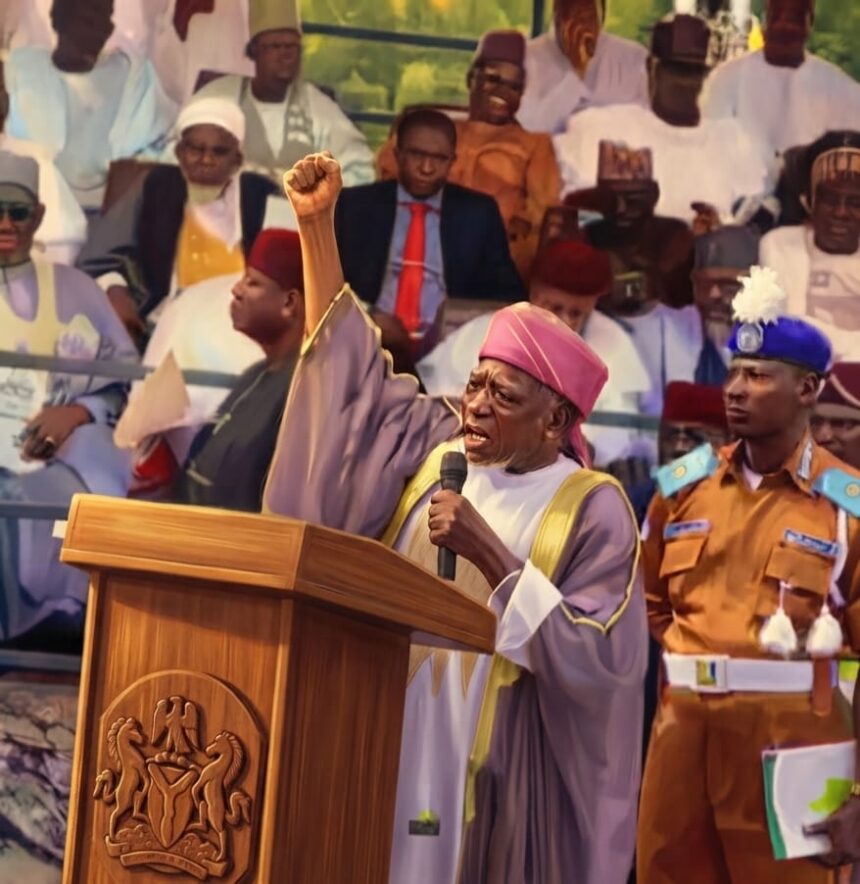
There is a disturbing video circulating on social media in which an Islamic preacher from northern Nigeria addresses a large gathering and makes statements that should trouble every Nigerian who believes in equal citizenship and the unity of the country.
In the video, the cleric reportedly urges Muslims to continue supporting the Muslim-Muslim ticket because, according to him, Nigeria is an Islamic country. He refers to Christians as infidels by implication. Those uncomfortable with the ticket are told they can leave the country. Muslims, he declares, must continue to demonstrate their dominance.
If the video accurately represents his words, this is not merely political rhetoric gone too far. It is an assault on the idea of Nigeria as a country belonging equally to all its citizens.
One could dismiss the speaker as just another individual expressing a personal opinion. Ordinarily, that would be reasonable. But this is where the matter becomes more troubling: the cleric is reportedly a prominent figure associated with one of the country’s influential Islamic organisations and several serving Northern governors were reportedly present at the gathering, alongside visible security personnel.
So the question is unavoidable: what did they make of what they heard? Did anyone challenge him? Have the governors, the Presidency or Northern political and traditional leaders unequivocally rejected the suggestion that Nigeria is an Islamic country or that Muslims have a superior claim to political dominance?
If they have, Nigerians should hear them clearly. If they have not, their silence is troubling.
To be fair, a leader’s presence at an event does not mean they endorse everything said from the podium, and a video clip should not be treated as conclusive proof of agreement. But statements of this magnitude demand an equally unambiguous repudiation from those in positions of authority. Silence does not necessarily prove agreement — but when no one is willing to say ‘not in our name’, citizens have every right to become uneasy.
Nigeria has travelled this road before. We know what happens when religion becomes a political weapon and when citizens are taught to see fellow Nigerians not as neighbours but as unbelievers or people whose rights are somehow inferior to theirs.
Democracy is not the domination of one religion by another; it is the protection of every citizen’s right to participate equally in political life.
Nigeria is not a Muslim country or a Christian country. It belongs to Muslims, Christians, traditional worshippers and Nigerians who profess no religion at all. That distinction matters. Once political power is treated as a religious entitlement, compromise becomes weakness and opposition becomes betrayal.
This is why dismissing such rhetoric as ‘just preaching’ is dangerous. Words matter, particularly when they come from influential people speaking before thousands.
But there is another danger we must avoid: turning legitimate criticism of religious extremism into an indictment of an entire religion. Millions of Nigerian Muslims reject religious supremacy and believe sincerely in peaceful coexistence. They are not responsible for one preacher’s words. Indeed, responsible Muslim leaders should be among the first to reject any suggestion that Islam gives one group ownership of Nigeria.
The same standard must apply to Christians.
Imagine a Christian preacher telling a crowd that Nigeria belongs exclusively to Christians and that Muslims who disagree should leave. The outrage — and the expectation of condemnation from political leaders — would be immediate and justified. The standard cannot shift because the identity of the speaker has changed.
If religious supremacy is wrong, it is wrong whoever promotes it.
This is also why grievances such as those raised around Mazi Nnamdi Kanu and the wider question of marginalisation cannot simply be brushed aside. One may disagree profoundly with Kanu’s methods or objectives, but grievances about exclusion and unequal citizenship do not disappear because they are inconvenient. A country serious about unity must confront them honestly — without answering one form of domination with another form of extremism.
If some Nigerians believe the country belongs to them and others believe they must permanently resist that domination, we face a deeper national crisis than any election can solve.
The answer is not violence, intimidation or reciprocal hatred. It is constitutional democracy, equal citizenship, justice and — where necessary — an honest conversation about the future of the federation.
Those who govern us have a responsibility to speak. The Presidency should speak. The governors who were present should speak. Northern political and traditional leaders and responsible Islamic scholars should speak.
Not tomorrow. Not when the controversy has faded from social media. Now.
They should tell Nigerians plainly whether they reject the idea that Nigeria belongs to one religion and whether they affirm the equal citizenship of every Nigerian.
Because Nigeria cannot survive on the fiction that one group is destined to dominate while others are expected to submit.
The country belongs to all of us.
And when a voice speaks of religious dominance from a public platform, the least Nigerians deserve from their leaders is the courage to say: ‘Not in our name.’
Okiwelu Azed P. writes from Asaba.