


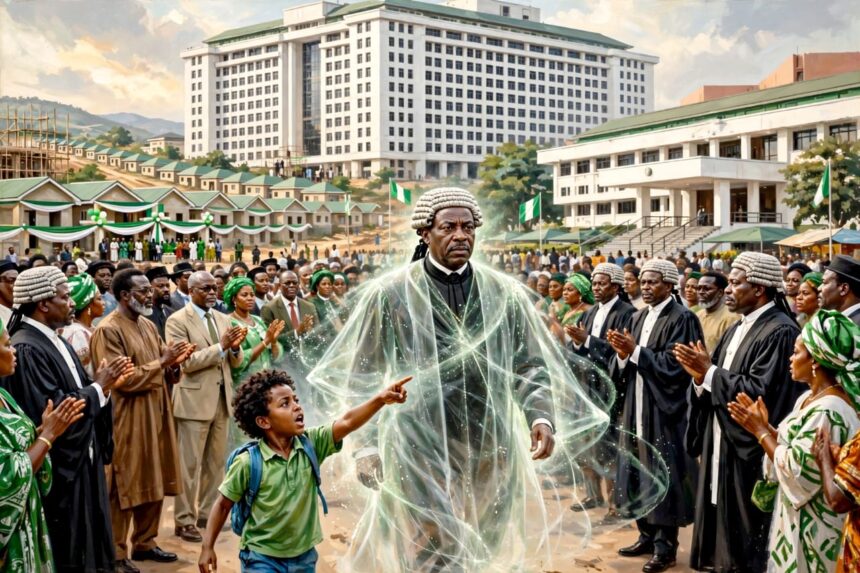
The Emperor’s New Robes: A Nigerian Judicial Tale
‘There should be no reason for the executive to build houses for judges. The judiciary is an independent arm of government and ought to have its own funding. If judges require accommodation, that responsibility rests with the Chief Justice of Nigeria through the judiciary’s independent procurement process. Forty houses built by the Tinubu administration raise serious questions. Nigeria has well over a thousand judges. If this is truly about judicial welfare, then every judge should benefit under a transparent policy, not a privileged few.’
Those were the words of Magaji Mato, SAN. They were not merely a criticism of a housing project. They were a warning about the gradual erosion of judicial independence.
More than a century ago, Hans Christian Andersen told the story of a vain emperor persuaded that he wore the most magnificent robe ever woven. The cloth, the swindlers claimed, could be seen only by the wise and the worthy. Terrified of appearing foolish, ministers praised what did not exist. Governors admired invisible embroidery. Courtiers applauded imaginary splendour. The entire kingdom joined the charade while the emperor unknowingly paraded through the streets completely naked.
Then an innocent young boy, who had no office to protect and no reputation to defend; untouched by fear or self-interest, looked up, spoke the obvious truth.
‘The Emperor has no clothes!’
That single truth shattered the conspiracy of silence.
That old fable increasingly mirrors the condition of Nigeria’s judiciary.
For years, rumours have circulated that certain politicians ‘own’ certain judges. Courtrooms established to dispense impartial justice have, in the public imagination, become arenas where political influence sometimes appears to outweigh the rule of law. Whether every allegation is true is almost beside the point. The deeper tragedy is that public confidence has steadily ebbed.
Mato merely articulated what many Nigerians have whispered for years. His concern over the executive constructing forty houses for judges goes beyond bricks and mortar. It strikes at a constitutional principle. The judiciary is not a department of the executive. It is a separate arm of government. If judges require official accommodation, it should be funded and administered independently by the judiciary itself, not presented as executive generosity.
The question therefore becomes unavoidable: why forty houses? Nigeria has well over one thousand judges and justices. By what criteria were the beneficiaries selected? If the policy is genuinely intended to strengthen judicial welfare, why should only a handful benefit? Selective generosity easily creates selective loyalty and even where none exists, the perception alone is corrosive.
This is precisely how Andersen’s invisible robe was woven.
The robe was not cloth. It was perception. It was the illusion that everyone must admire what no one dared question.
Today the robe is woven with comforting phrases such as ‘judicial welfare’, ‘support for the judiciary’ and ‘institutional assistance’. They sound noble. Yet when the executive begins providing selective benefits to judges, the appearance of independence becomes just as important as independence itself. Justice must not only be done; it must also be seen to be done.
The greatest danger is not merely corruption. It is the normalisation of silence.
Lawyers often speak cautiously because they must continue appearing before the same courts. Politicians exploit the system. Citizens gradually lose faith. Everyone applauds the invisible robe while confidence in justice quietly disappears.
A democracy survives because its citizens believe judges cannot be bought, influenced or indebted to political power. Once that belief dies, elections cease to be decided primarily by voters. They become contests increasingly settled in courtrooms where public trust has already been compromised.
Andersen’s story was never really about an emperor. It was about a society that chose pretence over truth.
Nigeria’s challenge is no different.
The judiciary still wears its ceremonial robes. The wigs remain white. The gavels still strike. Judgments are delivered with solemn dignity. Yet beneath the symbolism, many citizens wonder whether justice itself remains fully clothed.
Someone must always play the role of the innocent child.
Someone must be willing to say what others fear to utter.
The Emperor has no clothes!
Only by confronting uncomfortable truths can Nigeria restore the dignity of its judiciary. Justice does not require gifts from the executive or robes woven from political patronage. It requires independence, integrity and public confidence.
Until then, the procession continues.
The Emperor marches.
The courtiers applaud.
The tailors smile.
And the nakedness remains visible to all who still have the courage to see.
Okiwelu, Azed P. writes from Asaba.