

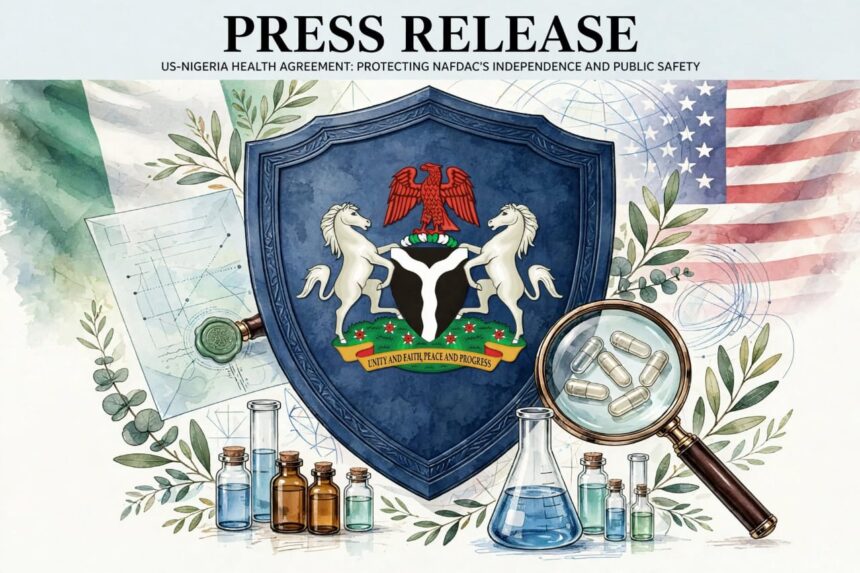
PRESS RELEASE
US–NIGERIA HEALTH AGREEMENT: PROTECTING NAFDAC’S INDEPENDENCE AND PUBLIC SAFETY
Nigeria needs international health assistance but no partnership should compromise regulatory independence, public accountability or the safety of its citizens.
The debate over Nigeria’s health cooperation agreement with the United States is not about rejecting foreign assistance. It is about ensuring that such support does not weaken the institutions responsible for protecting Nigerians.
Reports indicate that the five-year agreement involves nearly $2.1 billion in proposed US health assistance and almost $3 billion in new Nigerian health spending. The programme targets malaria, HIV/AIDS, tuberculosis, polio and maternal and child mortality, alongside improvements in disease surveillance, laboratory capacity and health-data systems.
These are important goals, but they must be pursued with transparency and adequate safeguards.
Reports that Ghana rejected a similar proposal over concerns about health data, pathogen samples, counterpart funding and medical-product inspections have heightened scrutiny of Nigeria’s agreement. However, Ghana’s reported decision does not establish that the two agreements contain identical provisions.
Likewise, available Nigerian material does not conclusively establish that the National Agency for Food and Drug Administration and Control (NAFDAC) has been barred from inspecting or testing medicines supplied under the agreement. References to regulatory reliance should not be confused with proof of a blanket inspection ban.
Claims that the vaccines or medicines are ‘lethal’ must not be treated as established facts. But neither should legitimate questions be dismissed as political mischief. Public confidence requires evidence, transparency and independent verification.
The Federal Government should publish the full agreement and clarify NAFDAC’s authority to inspect, sample, test, reject and recall products supplied under the programme. It should also disclose how health data and pathogen samples will be handled, how funds will be audited and what safeguards will ensure fair distribution.
Subsidised medicines are valuable but affordability must never replace safety oversight. Nigeria can welcome international assistance without compromising the independence of its regulatory institutions.
The demand is clear: publish the agreement, safeguard NAFDAC’s independence and subject its provisions to scrutiny by qualified Nigerian experts. Transparency is not an obstacle to healthcare; it is essential to protecting public health.
@Okiwelu Azed P.