


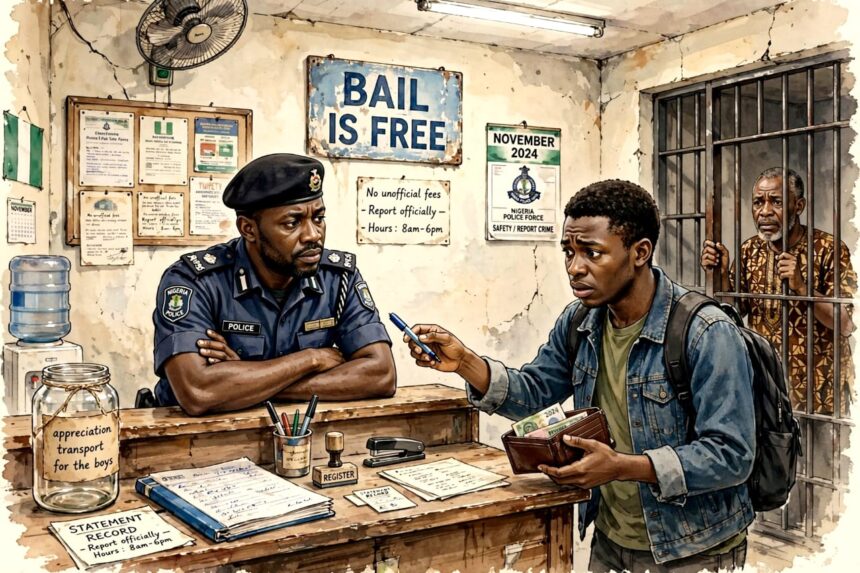
Bail Is Free — Just Don’t Forget Your Wallet!
‘Bail is free. Don’t pay police any money. If they ask you to pay, quietly go outside and call the IGP,’ a police spokesman has reportedly warned Nigerians — with the straight face of a man reading from a script written in a country that does not exist.
Wonderful advice. Almost too wonderful to be true.
There is only one small problem: this is Nigeria.
‘Quietly go outside and call the IGP’ sounds reassuring from an office in Abuja. But to the average Nigerian standing inside a police station with a relative behind the counter or, worse, inside a cell, it sounds less like policy and more like a comedy sketch.
Imagine the scene.
‘Officer, you are asking me to pay for bail.’
‘Who told you to pay?’
‘You did, sir.’
‘Then quietly go outside and call the IGP.’
Really?
At that point, the Nigerian may wonder whether he came to secure somebody’s freedom or has unknowingly enrolled in a practical examination titled: ‘How to Survive the Nigerian Police Station Without Going Broke.’
The law says bail is free. The spokesman says don’t pay. The citizen nods, grateful for the enlightenment.
Then he enters the station.
That is when the unofficial curriculum begins.
And it is not limited to bail.
Take the humble biro.
You arrive at the police station to write a statement.
‘Officer, please, can I have a biro?’
‘Biro?’
‘Yes, sir. I need something to write with.’
You may even have one in your pocket. Out of courtesy, you offer it to someone else who needs to write a statement.
Simple, isn’t it?
Not necessarily.
Somehow, the innocent business of getting a biro can become a test of whether you understand the common language of the Nigerian system.
You say you need a biro.
They look at you.
You look at them.
They look at the biro.
You look at the statement form.
And suddenly, you have committed the unforgivable offence of pretending not to understand.
‘You mean you don’t know what we are saying?’
You know.
They know that you know.
You know that they know that you know.
Nobody says it.
That is the unofficial language — hints, gestures, meaningful silence and strategically incomplete sentences.
And it is not peculiar to the police.
That is the larger point.
The police station is merely where the phenomenon is easiest to see. The same play runs across the Nigerian public system.
There is the official procedure, neatly displayed on a signboard or website. Then there is the procedure you are expected to understand without anybody officially explaining it.
A service may be declared free. Then someone quietly tells you what it will take to ‘move the file’.
A document may require one signature. You soon discover that the signature has developed legs and is touring from one desk to another.
A process may officially take three days. It takes three days — provided you know the ‘right person’, speak the ‘right language’ or understand the need to ‘settle’ the little things that apparently keep the machine moving.
Nobody calls it bribery.
It is ‘appreciation’.
It is ‘transport’.
It is ‘for refreshments’.
It is ‘to facilitate the process’.
It is ‘something for the boys’.
And once you understand the language, your wallet understands too.
Which brings us back to the police spokesman.
‘Don’t pay police any money. If they ask you to pay, quietly go outside and call the IGP.’
Quietly?
That single word deserves a standing ovation.
The Nigerian is expected to walk calmly out of a police station where his relative is detained because an officer has demanded money for a service the law says is free.
He should find a quiet corner, dial the IGP and say:
‘Good morning, sir. I am at a police station. An officer has asked me for money before releasing my brother. I have quietly stepped outside as instructed.’
What happens next?
Does the IGP answer personally?
Does the officer patiently wait?
Does the detainee remain in the cell while the complaint travels from the station to the command and perhaps from there to Abuja?
Or does another ‘small issue’ suddenly emerge?
Perhaps the statement is incomplete.
Perhaps another officer needs to be consulted.
Perhaps the investigating officer has stepped out.
Perhaps the file has gone for ‘attention’.
Perhaps somebody suddenly remembers that there is no biro.
And there it is: the absurdity of a system where even a pen can somehow become part of the national economic equation.
The problem, therefore, is bigger than police extortion.
It is a culture of unofficial payments, favours and expectations that has seeped into almost every corner of public life.
It is the culture that makes Nigerians ask, not ‘What is the official fee?’ but:
‘How much will it take to get this done?’
That single question tells us how deeply the problem has settled into our national consciousness.
We have become so accustomed to the unofficial that the official now sounds suspicious.
Tell a Nigerian something is completely free:
‘Free free?’
Tell him the process is straightforward:
‘Who do I know there?’
Tell him no payment is required:
‘But what will they expect?’
That is more than corruption. It is the psychology corruption leaves behind. It teaches citizens to anticipate extortion before anyone has even demanded it.
And that is why public enlightenment alone is not enough.
Don’t merely tell Nigerians:
‘Bail is free.’
Tell police officers:
‘Demanding money for bail is unacceptable and will attract real and swift consequences.’
Don’t merely tell citizens:
‘Call the IGP.’
Give them a safe, confidential and effective system for reporting extortion — one that does not require a frightened citizen to return to the very station where the offence occurred and announce that he has reported one of their own.
And the principle must extend beyond the police.
If government says a service is free, it should be free.
If a document requires no payment, nobody should have to ‘settle’ the desk officer to see it move.
If a process has an official timeline, citizens should not need a connection, a godfather or an envelope to make the file move.
If an official has a legitimate fee to collect, there should be a receipt.
Simple. Transparent. Accountable.
Three words that should not sound revolutionary.
To be fair, not every police officer is an extortionist. Many perform difficult and dangerous duties under challenging conditions and do so honourably. The same is true of public servants across the wider system who process files properly, ask for nothing and refuse to participate in the culture.
But their integrity should not become an excuse for ignoring the larger problem.
The real question is whether the system rewards compliance with the rules or rewards those who know how to circumvent them.
Until that changes, the police spokesman’s statement may remain both a welcome reminder and a national joke.
Because Nigerians know how these things work.
You may enter a station without a naira.
You may even arrive with your own biro.
You may know that bail is free.
You may know your rights.
You may know the law.
But somebody behind that counter may still look at you and wonder whether you have understood the assignment.
And if you say:
‘I have a biro. You can use mine.’
God help you.
You may have just demonstrated that you understand the common language — or, worse, that you are deliberately pretending not to.
That is the Nigeria we must change.
Not a Nigeria where citizens must learn an unofficial language to access official services.
Not a Nigeria where ‘free’ requires a footnote, a wink or an explanation.
Not a Nigeria where knowing your rights is easier than exercising them.
So yes: bail is free.
Nigerians should know that and hold officials to it.
But until the culture surrounding our public institutions changes, perhaps the safest national advice remains:
Know your rights — and don’t forget your wallet.
Because on paper, the system may be free.
In practice, somebody, somewhere, may still be waiting to ask:
‘But who will provide the biro?’
Okiwelu Azed P. writes from Asaba.